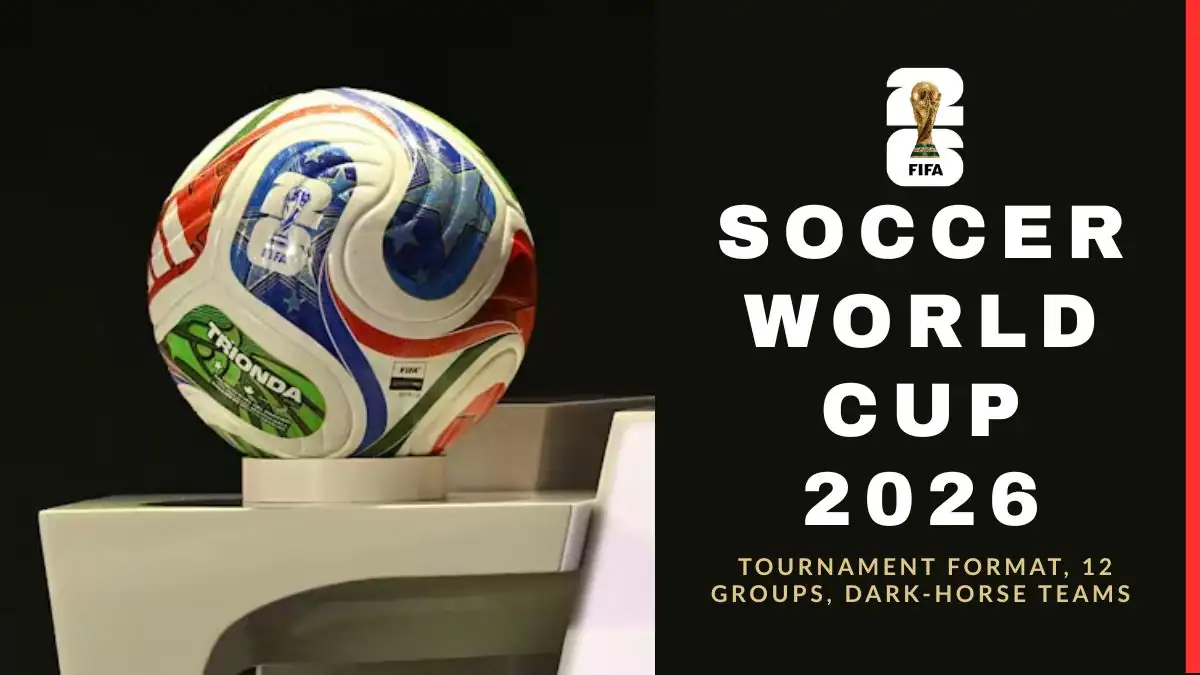
The FIFA World Cup 2026 is set to deliver a bigger and more thrilling format than ever before, featuring 48 teams divided into 12 groups. Co-hosted by the USA, Canada, and Mexico, this expanded edition brings more nations, more matches, and more drama. Here’s a complete look at all the Soccer World Cup 2026 Groups and the key storylines to watch.
The 2026 FIFA World Cup is all set to become the biggest edition ever. After the qualification process, 42 teams out of 48 teams have qualified for the competition across three host nations: the United States, Canada, and Mexico.
That means more countries, more matches — and a brand new draw format to accommodate the expanded field.
The group-stage draw will shape the destiny of 48 national teams, forming 12 groups for football’s greatest global showdown.
Soccer World Cup 2026 Groups and Tournament Format

The Soccer World Cup 2026 Groups are set — and the draw has delivered a mix of expected groupings, potential “groups of death,” underdog stories, and wildcard uncertainty.
From France vs Norway to England vs Croatia, Brazil’s challenge in a tricky group, and dark-horse teams eager to prove themselves in the Soccer World Cup 2026 Schedule. This World Cup tournament is shaping up to be one of the most open and exciting ever.
Tournament Format & How Teams Advance
- The group stage features 12 groups of four. Every team plays 3 matches (one against each group opponent).
- At the end of the group matches, the top two teams from each group (24 teams) automatically advance to the knockout stage. Additionally, the eight best third-placed teams (out of 12 groups) also qualify — forming a Round of 32.
- From the Round of 32 onwards: single-elimination knockout — Round of 16 → Quarterfinals → Semifinals → Final.
Groups
- Group A — Mexico, South Korea, South Africa, (UEFA Play-off D: Denmark / North Macedonia / Czechia / Ireland)
- Group B — Canada, Switzerland, Qatar, (UEFA Play-off: Italy / Northern Ireland / Wales / Bosnia)
- Group C — Brazil, Morocco, Scotland, Haiti
- Group D — USA, Australia, Paraguay, (UEFA Play-off C: Türkiye / Romania / Slovakia / Kosovo)
- Group E — Germany, Ecuador, Ivory Coast, Curaçao
- Group F — Netherlands, Japan, Tunisia, (UEFA Play-off B: Albania / Poland / Sweden / Ukraine)
- Group G — Belgium, Egypt, Iran, New Zealand
- Group H — Spain, Cape Verde, Saudi Arabia, Uruguay
- Group I — France, Senegal, Norway, (FIFA Play-off Tournament winner 2: Bolivia / Iraq / Suriname — placeholder)
- Group J — Argentina, Austria, Algeria, Jordan
- Group K — Portugal, Colombia, Uzbekistan, (FIFA Play-off Tournament winner 1: DR Congo / Jamaica / New Caledonia — placeholder)
- Group L — England, Croatia, Ghana, Panama
The 2026 World Cup isn’t just bigger — it’s structurally different.
The 48-team format features 12 balanced Soccer World Cup 2026 Groups and an expanded knockout phase, resulting in more nations, more matches, and greater chances for surprises.
For fans, it offers global drama. For underdogs, there’s a genuine opportunity at the world’s biggest stage. And for content creators and bloggers, it presents a wealth of stories, analyses, and heartbreaks waiting to unfold.
Where’s the “Group of Death”?
With so many teams and more slots in the knockout phase, the concept of a classic “Group of Death” is a bit vague — but that hasn’t stopped pundits from identifying the groups that are the toughest on paper. Two Soccer World Cup 2026 Groups stand out:
Group I — France, Senegal, Norway + Playoff winner
This group packs three strong, contrast-filled teams (and a wildcard). According to multiple analyses, Group I strikes the best balance of top-class pedigree and unpredictability — making it a strong candidate for the dreaded “group of death.”
- Why it’s tough: You’ve got powerhouses (France), hungry rising nations (Norway), a resilient African side (Senegal), and a playoff wildcard whose identity isn’t even known yet.
- What’s at stake: With only two or three advancing (top two + maybe best third), no game is safe — even for favorites.
Group L — England, Croatia, Panama, Ghana
Group L features seasoned giants England and Croatia, both with extensive recent major-tournament experience, alongside tricky outsiders Ghana and Panama, ensuring tense battles.
- Key challenge: Two top European nations; but even a slip-up vs Ghana or Panama could put heavy pressure.
- Why it scares fans: Good teams rarely guarantee safe passage — every match matters, especially given the unpredictable nature of third-place qualification.
Others to watch:
- Group C (Brazil + Morocco + Scotland + Haiti) — heavyweights + a dark-horse African side + underdog: this mix could lead to surprises.
- Group F — With the Netherlands, Japan, and Tunisia plus a potent playoff side, this group might surprise based on form & cohesion.
Top Picks & Dark-Horse Teams
Here’s a quick look at notable teams who look well-placed — and some underdogs who could spring surprises.
- Favorites to qualify easily: Brazil (Group C), Germany (E), Netherlands (F), Spain (H), Argentina (J), France (I), England (L) — consistent pedigree and quality.
- Most dangerous dark-horses: Senegal (I), Morocco (C), Côte d’Ivoire (E) — African teams often punch above their weight in World Cups.
- Playoff-winner wildcards: Whoever qualifies via UEFA or inter-confederation playoffs — could be underrated but dangerous, especially in balanced groups.
- Teams to watch: Scotland (C), Japan (F), Ivory Coast (E), Ghana (L) — could challenge the giants or create upsets with cohesion, momentum or tactical discipline.
Must-Watch Matches & Storylines

A few fixtures stand out as potential early classics — good for spectators, content creators, and bloggers alike:
- France vs Norway (Group I): Mbappe vs Haaland — just the clash of two generational talents; high drama likely.
- England vs Croatia (Group L): A rematch of recent major-tournament clashes. European rivalry, high stakes.
- Brazil vs Morocco (Group C): Traditional powerhouse vs rising African force. High-tempo, contrast-rich.
- Germany vs Ivory Coast (Group E): A test of German efficiency vs African flair — unpredictable, exciting.
- Netherlands vs Japan (Group F): Tactical football meets flair; could be a tight, well-contested group opener.
These matches, along with plenty of thrilling underdog-versus-giant showdowns, will bring plenty of excitement to the group stage and provide endless material for match reports, previews, and social media chatter.
What the 48-Team Format Means
Compared to past editions, the expanded 48-team format changes the dynamics significantly:
- More nations get a shot: Opportunities for underdog stories, surprise performances, and global representation.
- More knockout spots — but still tough: With top two + eight best third-placed teams advancing, even third place can be valuable — but nothing is guaranteed.
- Varied competitive balance: Some Soccer World Cup 2026 groups will be straightforward, others stacked. Unpredictability adds to drama.
- Wildcard potential: Playoff-winner slots and lower-ranked teams mean surprises can come from anywhere.
For fans and writers, that means more storylines, more drama — and more content.
How many teams will take part in the 2026 World Cup?
A total of 48 teams will participate — the largest number in World Cup history.
How are the teams divided into groups?
All 48 teams are placed into 12 groups (Groups A–L), with 4 teams per group.
How does the draw decide which team goes into which group?
Teams are seeded into four pots based on FIFA rankings and qualification status.
Each group receives one team from each pot to maintain competitive balance.
Are host nations placed in the same group?
No. The United States, Canada, and Mexico (the co-hosts) are pre-assigned to different groups to boost local fan engagement and scheduling balance.