


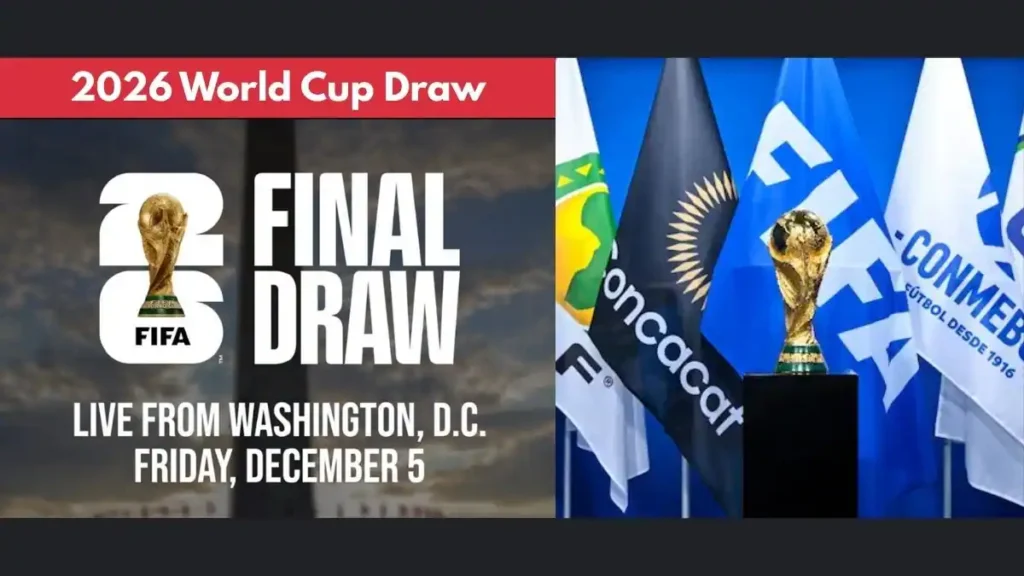
The 2026 World Cup draw is one of the most anticipated FIFA events in the soccer calendar, as it will determine the group stage matchups and set the stage for what promises to be the most expansive Soccer World Cup in history. With 48 teams competing for the first time, the draw ceremony will reveal which nations will face each other in the group stage, shaping potential knockout stage brackets and rivalries that could define the tournament.
Scheduled for December 5, 2025, at the Kennedy Center in Washington, D.C., the draw will create 12 groups of four teams each, with 42 of the 48 qualified teams already confirmed.
The remaining six spots will be determined through playoff matches in March 2026; however, placeholders will be assigned during the December draw to ensure every team knows its path to World Cup glory.
2026 World Cup Draw Date, Time, and Venue

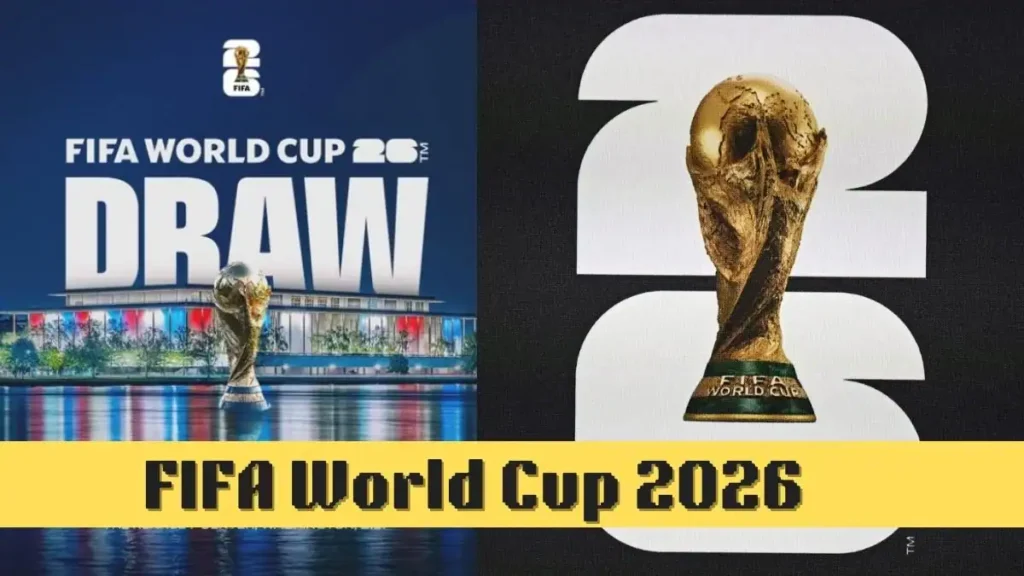
When and Where
- Date: Friday, December 5, 2025
- Time: 12:00 PM EST (5:00 PM GMT/UTC)
- Venue: John F. Kennedy Center for the Performing Arts, Washington, D.C., United States
The Kennedy Center, one of America’s premier cultural venues located on the banks of the Potomac River, will host this historic ceremony. U.S. President Donald Trump has confirmed he is scheduled to attend the draw, adding significant political and cultural significance to the event.
How to Watch
The 2026 World Cup draw will be broadcast live across multiple platforms globally:
- United States: FOX, FOX One, FOXSports.com, FOX Sports App
- International: FIFA’s official website (FIFA.com), FIFA’s YouTube channel, and select international broadcasters in each region
- Digital Streaming: Available on major social media platforms and digital services worldwide
Fans worldwide will be able to follow the draw in real-time, with live commentary, analysis, and reaction from soccer experts and former players.
2026 World Cup Draw Format and Structure
The Four Pots System
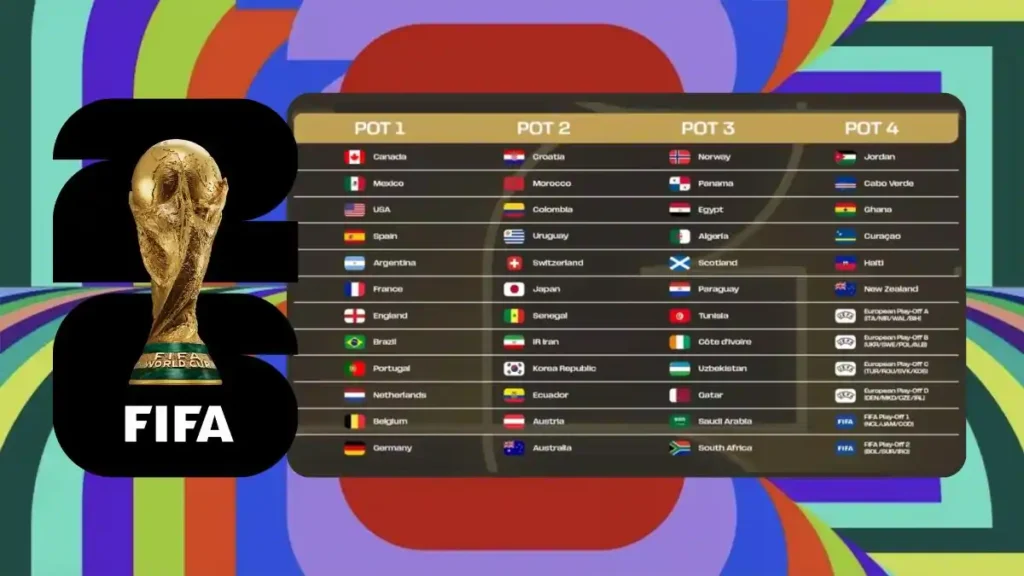
The 48 participating teams (or qualifying slots) will be divided into four pots of 12 teams each, based on the FIFA World Rankings published in November 2025. This pot system is designed to create balanced groups, taking into account teams’ current form and historical performance.
How Pots Work:
- Pot 1: Contains the three host nations (USA, Canada, Mexico) plus the top nine-ranked qualified teams
- Pot 2: Contains teams ranked 10-21 in FIFA rankings among qualified nations
- Pot 3: Contains teams ranked 22-33 among qualified nations
- Pot 4: Contains the lowest-ranked qualified teams plus six playoff placeholders
Each of the 12 groups (Groups A through L) will receive exactly one team from each pot, ensuring every group has a balanced mix of higher-ranked favorites and lower-ranked underdogs.
Confirmed Draw Pots
Based on the November 2025 FIFA World Rankings and qualified teams, here are the projected pots for the December 5 draw:
Pot 1 (Seeded Teams)
- Spain (Ranked #1)
- Argentina (Ranked #2, Defending Champions)
- France (Ranked #3)
- England (Ranked #4)
- Portugal (Ranked #5)
- Netherlands (Ranked #6)
- Brazil (Ranked #7)
- Belgium (Ranked #8)
- Germany (Ranked #9)
- United States (Host – Group D)
- Mexico (Host – Group A)
- Canada (Host – Group B)
The top nine FIFA-ranked teams that have qualified join the three automatic host qualifiers in Pot 1. These teams will be spread across all 12 groups, with the hosts pre-assigned to Groups A (Mexico), B (Canada), and D (USA).
Pot 2 (Next 12 Highest-Ranked Teams)
- Croatia (Ranked #10)
- Morocco (Ranked #11)
- Colombia (Ranked #13)
- Uruguay (Ranked #16)
- Switzerland (Ranked #17)
- Japan (Ranked #18)
- Senegal (Ranked #19)
- Iran (Ranked #20)
- South Korea (Ranked #21)
- Ecuador (Ranked #22)
- Austria (Ranked #23)
- Australia (Ranked #24)
Pot 2 features several dangerous teams including 2022 semifinalists Croatia, who narrowly missed Pot 1, and Morocco, who stunned the world with their fourth-place finish in Qatar. These teams could make for challenging draws for Pot 1 favorites.
Pot 3 (Middle-Ranked Qualified Teams)
- Tunisia (Ranked #26)
- Algeria (Ranked #27)
- Norway (Ranked #28)
- Saudi Arabia (Ranked #29)
- Qatar (Ranked #31)
- Egypt (Ranked #32)
- Ivory Coast (Ranked #33)
- Paraguay (Ranked #34)
- Ghana (Ranked #35)
- Scotland (Ranked #36)
- Panama (Ranked #38)
- South Africa (Ranked #40)
Pot 3 includes rising forces like Norway (featuring Erling Haaland), African champions Senegal’s regional rivals, and Scotland making their first World Cup appearance since 1998.
Pot 4 (Lowest-Ranked Teams + Playoff Placeholders)
- New Zealand (Ranked #42)
- Cape Verde (Ranked #43) – World Cup Debut
- Uzbekistan (Ranked #45) – World Cup Debut
- Jordan (Ranked #48) – World Cup Debut
- Curaçao (Ranked #49) – World Cup Debut, Smallest Nation Ever
- Haiti (Ranked #52)
- UEFA Playoff Winner (Path A) – Placeholder
- UEFA Playoff Winner (Path B) – Placeholder
- UEFA Playoff Winner (Path C) – Placeholder
- UEFA Playoff Winner (Path D) – Placeholder
- Intercontinental Playoff Winner (Path 1) – Placeholder
- Intercontinental Playoff Winner (Path 2) – Placeholder
Note: It is expected (but not officially confirmed) that FIFA will place all six playoff winners in Pot 4 regardless of their FIFA rankings. This approach has been used in past World Cups and would potentially create stronger groups containing higher-ranked playoff qualifiers like Italy or Denmark.
An alternative approach would be to assign playoff winners to pots based on their FIFA rankings, which could see teams like Italy (ranked #12) placed in Pot 2 if they qualify.
Draw Procedure: Step-by-Step

The draw ceremony will follow a structured procedure to ensure fairness and balance across all 12 groups:
Pre-Assigned Host Nations
Before the draw begins, the three host nations are already placed in specific groups:
- Mexico → Group A
- Canada → Group B
- United States → Group D
This pre-assignment ensures each host nation plays all three group stage matches in their own country, maximizing home advantage and fan engagement.
Drawing Process
Step 1: Pot 1 Allocation
- The nine non-host Pot 1 teams will be drawn one by one
- Each team will be assigned alphabetically to Groups C, E, F, G, H, I, J, K, and L
- Example: First team drawn goes to Group C, second to Group E, and so on
Step 2: Pot 2 Allocation
- All 12 teams from Pot 2 will be drawn
- Each team is assigned to the first available group (A through L)
- Subject to confederation restrictions (see below)
Step 3: Pot 3 Allocation
- All 12 teams from Pot 3 follow the same process
- Assigned to first available positions respecting the confederation rules
Step 4: Pot 4 Allocation
- The final 12 teams (including six placeholders) are drawn
- Complete all 12 groups with fourth team
- Playoff spots will be filled with actual teams once the March 2026 qualifiers are completed.
Important: Each pot is drawn in its entirety before moving to the next pot. The process is sequential: complete Pot 1, then Pot 2, then Pot 3, then Pot 4.
Confederation Restrictions
To ensure geographical diversity and competitive balance, FIFA enforces strict confederation restrictions:
The Rules
- No Same-Confederation Groups: Teams from the same confederation (UEFA, CONMEBOL, CAF, AFC, CONCACAF, OFC) cannot be drawn into the same group
- UEFA Exception: Because 16 European (UEFA) teams will qualify, it’s mathematically impossible to avoid UEFA clashes
- Four Groups with Two UEFA Teams: Exactly four groups will contain two UEFA teams each, while the other eight groups will have maximum one UEFA team
Confederation Distribution (48 Teams)
- UEFA (Europe): 16 teams
- CAF (Africa): 9 teams
- CONMEBOL (South America): 6 teams
- AFC (Asia): 8 teams
- CONCACAF (North/Central America & Caribbean): 6 teams (including 3 hosts)
- OFC (Oceania): 1 team
How This Impacts the Draw
When drawing teams from each pot, if a team cannot be placed in a particular group due to confederation restrictions (e.g., two South American teams already in the group), they must be assigned to the next available group that meets the criteria.
For example:
- If Brazil (CONMEBOL) is in Group C, no other South American team can be drawn into Group C
- If Spain (UEFA) and Germany (UEFA) are in Group E, that group’s two UEFA slots are filled
- Asian teams (AFC) can only go into groups that don’t already have an AFC representative
Remaining Qualification Spots
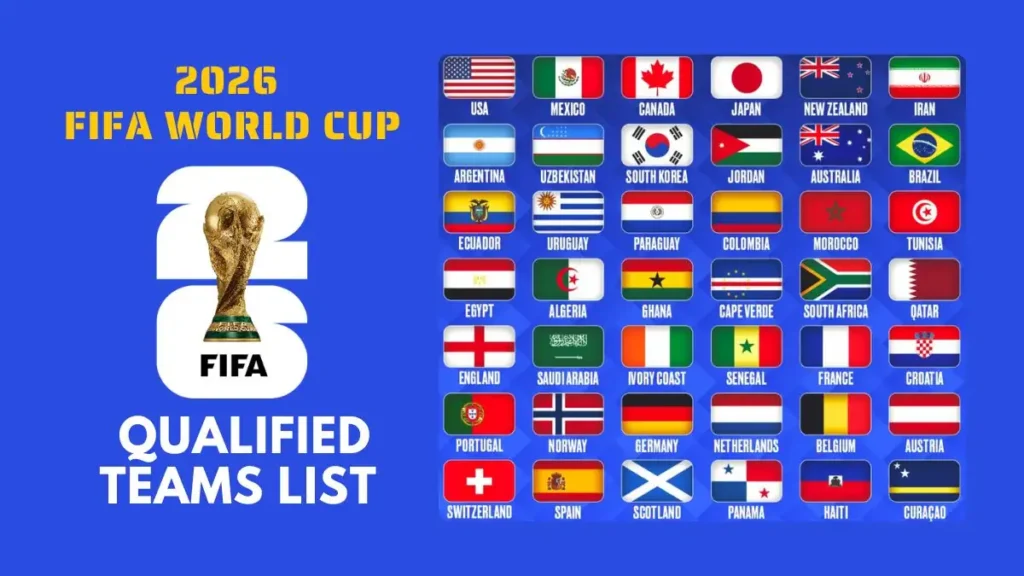
While 42 teams have already qualified for the 2026 World Cup, six spots remain open and will be determined through playoff tournaments in March 2026.
UEFA Playoffs (4 Spots Available)
The European playoffs feature 16 teams competing for four World Cup berths through four separate paths. Each path has two semifinals and one final, all single-leg knockout matches.
Draw Date: November 20, 2025 (already completed)
Match Dates: Semifinals – March 26, 2026 | Finals – March 31, 2026
Format: Single-elimination knockout at home venues
Path A
Semifinals:
- Italy vs. Northern Ireland
- Wales vs. Bosnia and Herzegovina
Final: Winner of Italy/Northern Ireland vs. Winner of Wales/Bosnia and Herzegovina
Key Storyline: Four-time world champions Italy are desperate to avoid missing a third consecutive World Cup after playoff failures in 2018 and 2022. They could face North Macedonia again, the team that eliminated them in 2022.
Path B
Semifinals:
- Ukraine vs. Sweden
- Poland vs. Albania
Final: Winner of Ukraine/Sweden vs. Winner of Poland/Albania
Key Storyline: Ukraine seeks to overcome challenging circumstances to reach their first World Cup since 2006. Poland features star striker Robert Lewandowski aiming for potentially his final World Cup appearance.
Path C
Semifinals:
- Turkey vs. Romania
- Slovakia vs. Kosovo
Final: Winner of Turkey/Romania vs. Winner of Slovakia/Kosovo
Key Storyline: Turkey, ranked in the Top 25 globally, is the favorite but faces strong competition from emerging nations.
Path D
Semifinals:
- Denmark vs. North Macedonia
- Czech Republic vs. Republic of Ireland
Final: Winner of Denmark/North Macedonia vs. Winner of Czech Republic/Republic of Ireland
Key Storyline: Denmark narrowly missed automatic qualification after a surprise loss to Norway. The Irish seek their first World Cup appearance since 2002.
Intercontinental Playoffs (2 Spots Available)
Six teams from various confederations will compete in two playoff paths for the final two World Cup berths. The tournament will be held in Mexico (Guadalajara and Monterrey).
Match Dates: Semifinals – March 26, 2026 | Finals – March 31, 2026
Format: Single-elimination knockout at neutral venues in Mexico
Playoff Path 1
Semifinal: New Caledonia vs. Jamaica
Final: Winner vs. DR Congo (seeded, direct to final)
Confederation Breakdown:
- New Caledonia (OFC)
- Jamaica (CONCACAF)
- DR Congo (CAF – ranked #56, seeded directly to final)
Playoff Path 2
Semifinal: Bolivia vs. Suriname
Final: Winner vs. Iraq (seeded, direct to final)
Confederation Breakdown:
- Bolivia (CONMEBOL)
- Suriname (CONCACAF)
- Iraq (AFC – ranked #58, seeded directly to final)
Key Details:
- DR Congo and Iraq were seeded directly to the finals based on their superior FIFA World Rankings
- Jamaica and Suriname (both CONCACAF) were deliberately drawn into separate paths to avoid the same-confederation matchups
- These matches will serve as test events for the World Cup 2026 infrastructure
What Happens After the Draw?
Placeholder Assignment
During the December 5 draw, the six unqualified spots will be shown as placeholders, each labeled as:
- UEFA Playoff Winner (Path A, B, C, D)
- Intercontinental Playoff Winner (Path 1, 2)
Each placeholder will be drawn into a specific group, and once the March 2026 playoffs conclude, the actual qualified teams will take those positions.
Match Schedule Assignment
Along with learning their group opponents, the draw will determine:
- Which stadiums each team will play in for their three group matches
- Match dates and kick-off times
- Team base camp assignments
- Training facility allocations
Complete Tournament Bracket
The draw will also establish the knockout stage bracket structure, showing potential paths teams would take if they advance from their groups. This creates early storylines about potential matchups in the Round of 32, Round of 16, Quarter-Finals, and beyond.
For example:
- The winner of Group A will face a third-place team from Groups B/C/D in the Round of 32
- The runner-up of Group C will face the runner-up of Group D
- Potential semifinal matchups become clear based on bracket positioning
Historical Context and Significance
Why This Draw Matters
The 2026 World Cup draw is historically significant for several reasons:
First 48-Team Draw: This is the first time FIFA will draw 48 teams into groups, marking the most significant expansion in modern World Cup history.
Three-Nation Tournament: The draw must accommodate the unique constraint of three host nations, each pre-assigned to specific groups with guaranteed home matches.
Extended Knockout Stage: With the new Round of 32, the bracket paths become even more critical, as teams will play eight matches (instead of seven) to become champions.
Placeholder Complexity: Drawing six placeholders before teams are known adds an element of mystery and anticipation, as groups could become significantly stronger or weaker depending on which playoff teams qualify.
Impact on Tournament Narrative
The draw will immediately create storylines that dominate headlines until the tournament begins:
Group of Death: With stronger Pot 2 and Pot 3 teams due to the expanded format, at least one group will be labeled the “Group of Death” featuring multiple title contenders.
Revenge Matches: Potential rematches of historic encounters (Brazil vs. Germany 2014, Argentina vs. France 2022) could occur in group stages.
Host Nation Pressure: USA, Mexico, and Canada will immediately know the scale of their challenge and whether they have favorable draws for home advantage.
Debutant Spotlight: First-time participants like Curaçao, Jordan, Cape Verde, and Uzbekistan will learn which global powerhouses they’ll face in their World Cup debuts.
Potential Dream and Nightmare Scenarios
Favorable Draw Examples
For Top Seeds (Pot 1):
- Pot 2: Austria or Ecuador (lower-ranked Pot 2 teams)
- Pot 3: Panama or Ghana
- Pot 4: Haiti or New Zealand
For Mid-Tier Teams (Pot 2/3):
- Avoiding multiple Pot 1 giants
- Drawing debutant nations from Pot 4
- Favorable travel and venue assignments
Challenging Draw Examples
Group of Death Scenario:
- Pot 1: Germany or Brazil
- Pot 2: Croatia or Morocco
- Pot 3: Norway (with Haaland) or Scotland
- Pot 4: Italy (if they qualify via playoffs and placed in Pot 4)
Nightmare for Hosts:
- USA draws: Argentina, Croatia, and potential Italy
- Mexico draws: Spain, Japan, and Norway
- Canada draws: France, Uruguay, and potential Denmark
Expert Predictions and Analysis
Most Likely Pot 1 Teams to Struggle
Despite being seeded, the United States, Mexico, and Canada face unique challenges as host nations in Pot 1 with lower FIFA rankings (14th, 15th, and 41st, respectively). They could draw exceptionally strong groups:
- USA (Ranked #14): Could face Croatia, Norway, and Italy
- Mexico (Ranked #15): Could draw Netherlands, Morocco, and Tunisia
- Canada (Ranked #41): Faces the steepest challenge with a potential France, Uruguay, and Norway draw
Dark Horse Groups
Watch for groups containing:
- Norway (Pot 3): Erling Haaland’s presence makes any group dangerous
- Morocco (Pot 2): 2022 semifinalists could upset top seeds again
- Japan (Pot 2): Consistent performers who’ve eliminated European giants before
Playoff Impact
If higher-ranked teams like Italy (#12), Denmark (#25), or Turkey (#26) qualify through playoffs and are placed in Pot 4, they would create exceptionally difficult groups for their Pot 1 opponents.
Draw Day Atmosphere and Ceremony
Expected Attendees
The ceremony will feature:
- FIFA President Gianni Infantino
- U.S. President Donald Trump and Vice President JD Vance
- Soccer legends and World Cup ambassadors
- National team representatives from qualified nations
- Celebrities and cultural figures
Ceremony Format
The event typically includes:
- Opening remarks from FIFA officials and host nation representatives
- Video presentations celebrating World Cup history
- Performance from musicians or cultural acts
- The actual draw process with live ball selections
- Analysis and reaction from Soccer experts
- Interviews with team representatives
Global Broadcast
The draw will be one of the most-watched Soccer events of 2025, with hundreds of millions tuning in globally to see their nation’s fate determined live.
Key Dates Following the Draw
December 5, 2025: Official World Cup draw
December 2025 – March 2026: Playoff preparation and build-up
March 26, 2026: UEFA and Intercontinental playoff semifinals
March 31, 2026: Playoff finals determine last six qualifiers
April 2026: Final groups confirmed with all 48 teams
May 24, 2026: Final club matchday for World Cup players
May 25-30, 2026: Players released to national teams
June 2026: Pre-tournament training camps and friendlies begin
June 11, 2026: Tournament kicks off at Estadio Azteca, Mexico City
How to Follow the Draw of the 2026 World Cup
Official Sources
- FIFA.com: Live stream and minute-by-minute updates
- FIFA YouTube: Live broadcast with commentary
- FIFA Social Media: Twitter (@FIFAWorldCup), Instagram, Facebook for real-time reactions
What to Watch For
- Group Assignments: Which groups become the toughest?
- Host Nation Draws: Do USA, Mexico, and Canada get favorable matchups?
- Rivalry Potential: Are historic rivals drawn together?
- Debutant Reactions: How do first-time nations respond to their draws?
- Travel Implications: Which teams get clustered venues vs. cross-country travel?
- Bracket Paths: Which side of the knockout bracket looks stronger?
Conclusion
The December 5, 2025 World Cup draw at the Kennedy Center represents the moment when the 2026 FIFA World Cup tournament truly begins to take shape. With 48 teams, 12 groups, and six playoff placeholders, this draw will be the most complex and consequential in World Cup history.
For Soccer fans worldwide, the draw creates immediate anticipation and storylines that will dominate conversations for the next six months. Whether your nation draws a favorable group or faces the dreaded “Group of Death,” the path to World Cup glory becomes clear on December 5.
From the opening match on June 11, 2026 in Mexico City to the final on July 19 at MetLife Stadium in New Jersey, every team’s journey begins with the draw. The blend of established powerhouses, emerging forces, and debutant nations promises to deliver the most unpredictable and exciting World Cup in history.
As FIFA expands the tournament to new heights, the draw ceremony serves as the perfect curtain-raiser for what will be an unforgettable summer of Soccer across North America. No matter which teams are drawn together, one thing is certain: the 2026 FIFA World Cup will captivate the world.
Mark your calendar: December 5, 2025, 12:00 PM EST. The journey to World Cup glory begins with the draw.