


The 2026 FIFA World Cup will feature 48 teams for the first time, co-hosted by the United States, Canada, and Mexico. Three host nations qualified automatically, while the remaining spots are filled through six continental confederation qualification processes.
The road to the FIFA World Cup 2026 is heating up, and fans around the globe are eager to know which nations have already secured their place
As the qualifications have been completed across different continents, all the teams have officially secured their spots in the tournament. Here’s an updated look at the confirmed qualified teams so far.
How Many Teams Have Qualified for the FIFA World Cup 2026?

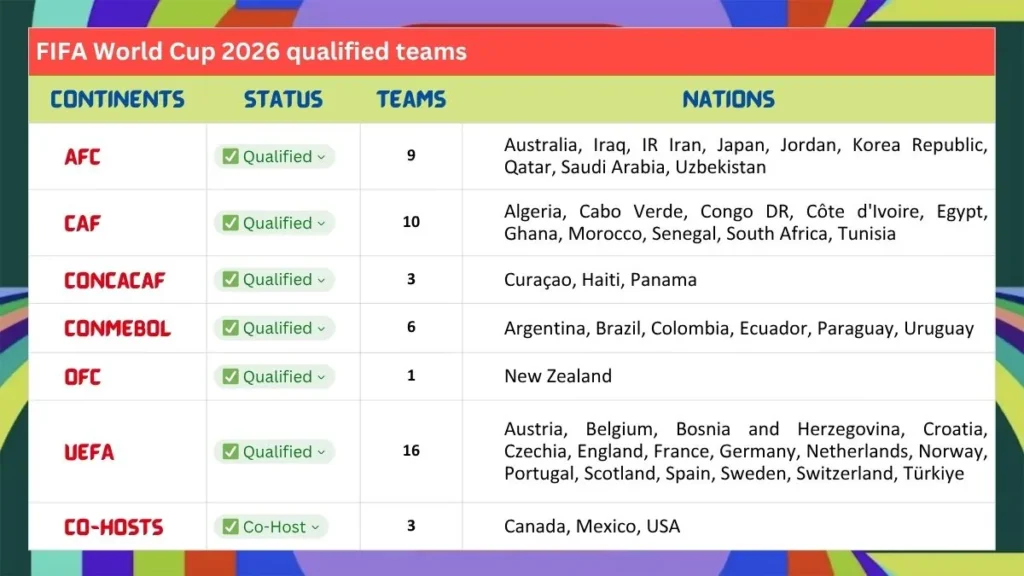
FIFA World Cup 2026 qualification is completed, and several nations have already secured their spots in the tournament. Here’s a look at the teams that have qualified so far.
As of now, 48 nations have already secured their spots at the FIFA World Cup 2026. Some teams have joined through continental qualification, and more teams are joining as co-hosts. The final lineup of 48 teams has been confirmed by March, 31 2025.
Total Qualified Teams
- Qualified so far: 48
- Slots remaining: 0
- 48 teams will compete in the World Cup for the very first time
- The tournament will feature 12 groups of four teams
Breakdown by Confederation
| Confederation | Qualified Teams (Count) |
|---|---|
| CONCACAF | United States, Canada, Mexico (3) |
| AFC | Australia, Iraq, IR Iran, Japan, Jordan, South Korea, Qatar, Saudi Arabia, Uzbekistan (9) |
| CONMEBOL | Argentina, Brazil, Ecuador, Uruguay, Colombia, Paraguay (6) |
| OFC | New Zealand (1) |
| CAF | Algeria, Cabo Verde, Congo DR, Côte d’Ivoire, Egypt, Ghana, Morocco, Senegal, South Africa, Tunisia (10) |
| UEFA | Austria, Belgium, Bosnia and Herzegovina, Croatia, Czechia, England, France, Germany, Netherlands, Norway, Portugal, Scotland, Spain, Sweden, Switzerland, Türkiye (16) |
CONCACAF (Hosts)

United States: As co-hosts, the U.S. Men’s National Team bypassed qualification and will appear in their 11th consecutive World Cup, aiming to capitalize on home-field advantage and build on their quarterfinal finish in 2014 and Round of 16 in 2022.
Canada: Automatically qualified as co-hosts for only their second-ever World Cup appearance (first since 1986), looking to showcase rapid recent growth after reaching the 2022 World Cup and winning their first CONCACAF Gold Cup in 2021.
Mexico: With automatic entry as co-hosts, Mexico extends its streak to a 17th straight World Cup, seeking to overcome past Round of 16 exits and leverage strong domestic league support.
AFC (Asia)

Japan: Clinched qualification by topping their final-round group, marking their seventh straight World Cup, highlighted by disciplined defense and a technical style under coach Hajime Moriyasu.
Iran: Secured their sixth consecutive World Cup berth through a robust qualification campaign, led by captain Sardar Azmoun’s 15 goals and a strong home record at Tehran’s Azadi Stadium.
Uzbekistan: Qualified for the first time since 2006 thanks to a balanced squad featuring playmaker Odil Ahmedov, finishing second in their group with 18 goals scored in qualifiers.’South Korea: Earned their 11th straight appearance by finishing atop their final group, driven by Tottenham’s Son Heung-min and a resilient backline that conceded just four goals in ten matches.
Jordan: Celebrated a maiden World Cup qualification by finishing among the top two teams in their final Asian group, powered by a cohesive defense and striker Musa Al-Taamari’s breakout form.
Australia: Booked their sixth consecutive World Cup spot through disciplined performances in the Asian zone, with emerging talents like Garang Kuol complementing veterans such as Aaron Mooy.
South Korea: Korea Republic reached their 11th consecutive World Cup, continuing their long run as one of Asia’s most reliable qualifiers.
Qatar: Qatar sealed direct qualification for the FIFA World Cup 2026, adding another appearance after their 2022 host campaign.
Saudi Arabia: Saudi Arabia reached a third consecutive World Cup after finishing strongly in the AFC qualifying rounds.
Iraq: Iraq grabbed the final World Cup 2026 spot by winning the FIFA World Cup 2026 Play-Off Tournament, becoming the 48th team in the lineup.
CONMEBOL (South America)

Argentina: Qualified as group winners and reigning 2022 champions, led by Lionel Messi’s inspirational play and a balanced squad that conceded only six goals in 18 qualifiers.
Brazil: Clinched top position in South America’s toughest qualifying group, showcasing dynamic attack spearheaded by Neymar and Vinícius Jr., and a renewed defensive stability under coach Tite.
Ecuador: Secured their place with a third-place finish, thanks to Enner Valencia’s 12 goals and a fast-paced style that yielded the second-highest goal tally in CONMEBOL qualifiers.
Uruguay: Booked qualification through solid home form and veteran leadership from Luis Suárez and Diego Godín, finishing fourth in a deeply competitive South American table.
Colombia: Returned after missing the 2022 tournament by finishing fifth this cycle, propelled by James Rodríguez’s playmaking and a strong defensive record in away fixtures.
Paraguay: Claimed the final automatic berth in sixth place, benefiting from a well-organized team structure and emerging striker Miguel Almirón’s direct running and creativity.
OFC (Oceania)

New Zealand: Secured Oceania’s lone automatic spot for the second time ever, dominating qualifiers under coach Danny Hay and relying on attacker Chris Wood’s experience to guide a youthful squad.
CAF (Africa)

Morocco: Qualified as group winners for a fourth consecutive World Cup, building on their historic 2022 semifinal run with a free-scoring attack led by Hakim Ziyech.
Tunisia: Claimed their seventh World Cup berth by topping their African qualifying group, leveraging disciplined tactics and goalkeeper Mouez Hassen’s crucial penalty-shootout heroics in the playoffs.
18 teams have secured qualification so far.
Algeria: Algeria is back at the FIFA World Cup 2026 after missing the last two editions, confirming their return with a strong qualifying finish.
Cabo Verde: Cabo Verde made history by qualifying for their first-ever FIFA World Cup, one of the biggest stories of the African qualifiers.
Congo DR: Congo DR booked their place through the FIFA Play-Off Tournament, ending a long wait for a return to the global finals.
Côte d’Ivoire: Côte d’Ivoire returned to the World Cup after topping Group F, securing qualification for the first time since 2014.
Egypt: Egypt punched their ticket by finishing top of Group A, setting up a fourth appearance at the FIFA World Cup.
Ghana: Ghana sealed qualification with a win over Comoros, earning their place at the FIFA World Cup for the fifth time.
Senegal: Senegal qualified by finishing first in Group B, continuing their strong recent record on the World Cup stage.
South Africa: South Africa secured a FIFA World Cup return, ending a 16-year absence from the tournament.
UEFA (European)
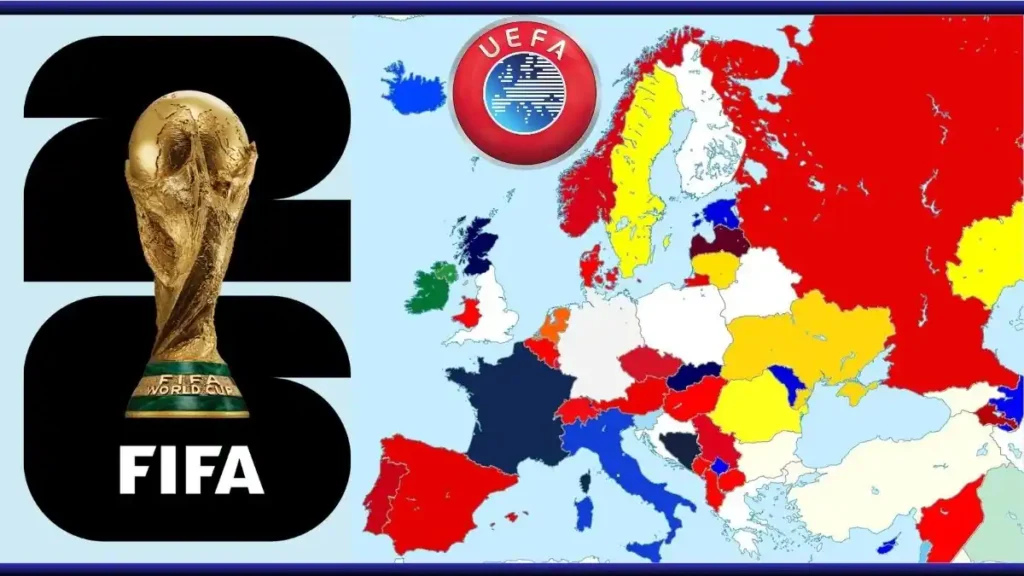
Austria: Austria secured their place at the FIFA World Cup 2026 after a strong UEFA qualifying campaign.
Belgium: Belgium booked qualification and will return to the World Cup stage in 2026.
Bosnia and Herzegovina: Bosnia and Herzegovina reached the FIFA World Cup 2026 through the UEFA play-offs after a dramatic qualifying run.
Croatia: Croatia confirmed their place among Europe’s qualified teams for the FIFA World Cup 2026.
Czechia: Czechia qualified for the FIFA World Cup via the UEFA play-offs, sealing their ticket in the final phase.
England: England secured qualification and will be back at the FIFA World Cup.
France: France booked their spot in the tournament as one of UEFA’s qualified nations.
Germany: Germany qualified for the FIFA World Cup after navigating the UEFA campaign successfully.
Netherlands: The Netherlands qualified comfortably and remain among Europe’s strongest World Cup contenders.
Norway: Norway secured their place at the FIFA World Cup and will be on the big stage again.
Portugal: Portugal qualified for the 2026 World Cup after another solid UEFA campaign.
Scotland: Scotland booked qualification and earned a place in the 2026 World Cup lineup.
Spain: Spain confirmed their spot in the 2026 World Cup as one of UEFA’s qualified sides.
Sweden: Sweden joined the final World Cup lineup through the UEFA play-offs.
Switzerland: Switzerland qualified for the FIFA World Cup 2026 after a strong European qualifying run.
Türkiye: Türkiye reached the FIFA World Cup 2026 through the UEFA play-offs to complete Europe’s late qualifiers.