The 2026 UEFA Soccer Rankings represent the most comprehensive measure of European Soccer excellence, determining which countries and clubs dominate the continental stage.
These rankings play a crucial role in deciding Champions League, Europa League, and Conference League allocations, making them essential for understanding European Soccer’s competitive landscape.
Most UEFA soccer teams dominate the 2026 Top Soccer Leagues World Rankings, with the Premier League, Serie A, La Liga, Bundesliga, and Ligue 1 among the leaders.
Understanding the UEFA Coefficient System
The UEFA coefficient system serves as European Soccer’s premier ranking mechanism, using weighted arithmetic means to evaluate both national associations and individual clubs.
Introduced in 1979 for men’s Soccer tournaments, the coefficients are calculated by UEFA and published in three formats: single season, five-year span, and ten-year span.
The ranking methodology rewards success across all UEFA competitions. Each team receives two points for a win and one point for a draw, with clubs reaching the Round of 16, quarterfinals, semifinals, and finals of the UEFA Champions League receiving one and a half additional points for each round. This comprehensive system ensures that sustained excellence gets properly recognized.
2026 UEFA Soccer Rankings: England Dominates

England tops the men’s association club rankings for the second year running with a coefficient of 111.797.
This dominance reflects the Premier League’s continued strength in European competitions, with multiple English clubs performing consistently across all UEFA tournaments.
Top 10 Country Rankings 2026
The current standings showcase the traditional powerhouses of European Soccer:
England’s Premier League remains at the top of the UEFA Country Coefficients ranking with a score of 111.797.
Italy holds second place with 96.446 points, followed by Spain at 90.484, Germany at 87.331, and France at 78.927. The Netherlands, Portugal, Belgium, Turkey, and Czechia round out the top ten, demonstrating the competitive depth across European Soccer.
England and Portugal currently occupy next season’s European Performance spots, earning each association one automatic place in the Champions League league phase for the club ranked next-best in their domestic league.
| Rank | Country | League | Coefficient | Remaining Teams |
|---|---|---|---|---|
| 1 | England | Premier League | 111.797 | 9/9 |
| 2 | Italy | Serie A | 96.446 | 6/7 |
| 3 | Spain | La Liga | 90.484 | 6/8 |
| 4 | Germany | Bundesliga | 87.331 | 6/7 |
| 5 | France | Ligue 1 | 78.927 | 5/7 |
| 6 | Portugal | Liga Portugal | 69.266 | 4/5 |
| 7 | Netherlands | Eredivisie | 66.595 | 1/6 |
| 8 | Belgium | Pro League | 60.850 | 2/5 |
| 9 | Türkiye | Süper Lig | 49.075 | 3/5 |
| 10 | Czechia | First League | 47.225 | 3/5 |
UEFA Club Rankings 2026: Real Madrid Reclaims Top Spot

In the club rankings, Real Madrid moved top in 2025 with 131.500 points, ending the three-year reign of Manchester City, after earning Champions League crowns in 2022 and 2024.
Top 10 Club Rankings
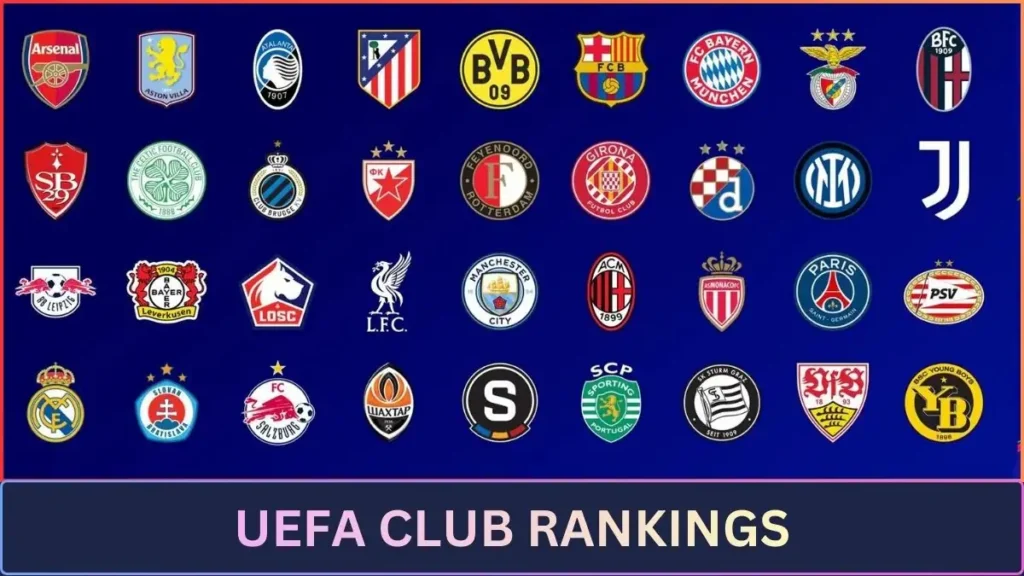
Bayern München ranks second with 124.250 points, Inter third with 121.250, Manchester City fourth with 117.750, and Liverpool fifth with 115.500. Paris Saint-Germain, Borussia Dortmund, Bayer Leverkusen, Barcelona, and Arsenal complete the elite top ten.
Three English clubs feature in the top ten men’s clubs, though there is no room for Tottenham and Chelsea, the holders of the UEFA Europa League and UEFA Conference League respectively.
How UEFA Rankings Impact European Competition
The 2026 UEFA Soccer Rankings directly influence European Soccer’s competitive structure. The association club coefficient rankings determine the number of entries an association is granted for forthcoming seasons, while club coefficient rankings determine a club’s seeding in competition draws.
Presently, England, Germany, Spain, and Italy each get seven spots – four for the Champions League and two for the Europa League. This allocation system rewards countries whose clubs perform consistently well across all European competitions.
The Five-Year Calculation Method
The UEFA country ranking of 2026 is determined by the sum of the UEFA country coefficients over the last 5 years. This rolling five-year window ensures that recent performances carry the most weight while maintaining stability in the rankings.
For individual clubs, the UEFA 5-year club ranking is determined by UEFA club points in the last 5 years, with a minimum of 20% of the 5-year country ranking, and this club ranking is used for the seeding of draws.
Historical Dominance in UEFA Rankings
Spanish clubs have historically dominated European Soccer’s coefficient rankings. Real Madrid has topped the UEFA coefficient the most times in 5 years, ranking as the leading team in Europe for the periods between 1988 and 1995, 1997 and 2005, and 2010 and 2019.
FC Barcelona and Juventus tie for second position with 7 points each on the list of the most dominant European sides since 1975, showcasing the sustained excellence required to maintain top rankings.
What the 2026 UEFA Soccer Rankings Mean for Future Competitions
The ranking at the end of the 2022–23 season determines the team allocation by association in the 2024–25 UEFA season, not the immediately following season. This means the 2026 rankings will shape European Soccer’s competitive landscape for the 2028-29 season.
The coefficients are updated directly after each completed round of UEFA club competition matches, ensuring the rankings remain current and reflect the latest performances.
The Significance of European Performance Spots
The European Performance Spots go to the associations with the best collective performance by their clubs in the previous season’s UEFA men’s club competitions, based on the association club coefficient.
This reward system incentivizes consistent excellence across all clubs from each association.
Conclusion: The Power of UEFA Rankings
The 2026 UEFA Soccer Rankings demonstrate European Soccer’s evolving competitive balance, with England’s dominance at the association level and Real Madrid’s return to the club summit.
These rankings will continue shaping European competition for years to come, determining which clubs compete at Soccer’s highest level and how many opportunities each country receives.
Understanding these rankings is essential for fans, clubs, and administrators alike, as they represent the most objective measure of footballing excellence across the continent.
As the 2025-26 season progresses, these rankings will continue evolving, potentially reshaping the landscape of European Soccer once again.