


When Pep Guardiola stepped onto the pitch at Premia de Mar on September 2, 2007, for his first game as Barcelona B manager against CE Premia, few could have imagined the extraordinary journey that would follow. That modest fourth-tier Spanish match, played before around 2,000 curious fans, marked the beginning of one of football’s most remarkable managerial careers.
The transformation from that goalless draw in Catalonia to becoming one of the most decorated and influential coaches in football history is a testament to Guardiola’s relentless pursuit of excellence, tactical innovation, and an unwavering commitment to playing beautiful, possession-based football.
Pep Guardiola is regarded as one of the greatest managers of all time. He coached Barcelona, Bayern Munich, and Manchester City.
The Humble Beginning of Pep Guardiola: Barcelona B and the Foundation (2007-2008)

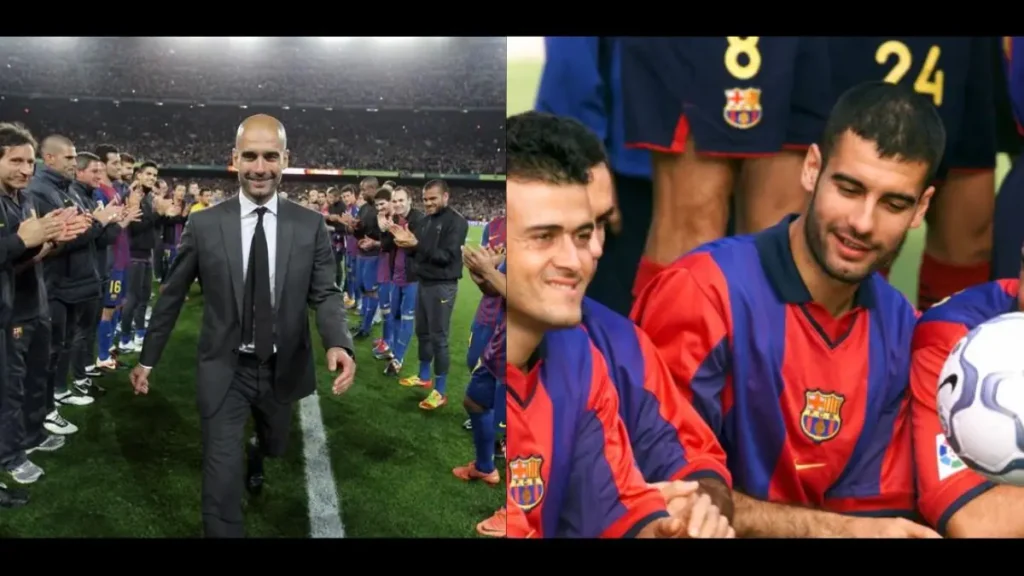
When Guardiola took over as Barcelona B manager, the team was at a low point, having just been relegated to the Tercera División, Spain’s fourth tier—an embarrassing blow for such a renowned club. But president Joan Laporta and sporting director Txiki Begiristain recognized potential in their former midfielder, who had recently earned his coaching qualifications.
The first match against Premia finished 0-0, but it showcased the early building blocks of Guardiola’s philosophy. From the start, he introduced high pressing, surprising opponents with the energy and determination of his young squad. While the system had its flaws—Premia almost snatched a late goal when Melo’s powerful free-kick rattled the crossbar—Guardiola’s vision was unmistakable.
His starting lineup that day included a young winger named Pedrito, who would later become known simply as Pedro—a player who went on to win Champions League, La Liga, Premier League, World Cup, and European Championship titles.
During the match, Pep Guardiola famously grabbed Pedro by his shirt and yanked him up after he fell claiming a foul, shouting for him to get back and defend—a moment that showed Guardiola’s demanding standards even in the fourth division.
The 2007-08 season with Barcelona B proved transformative. Despite early setbacks, Guardiola’s squad finished top of the Tercera División with 83 points, losing only five of 38 matches—the fewest of any team. They scored 70 goals and secured promotion through the playoffs, defeating CF Extremadura and Barbastro to reach Spain’s third tier.
For Guardiola, this achievement remains one of his proudest. It was a season of endless bus journeys through Catalonia, playing on uneven pitches and outdated astroturf where intricate tiki-taka had no place. Yet this experience laid the groundwork for everything that followed, teaching him adaptability and resilience.
Pep Guardiola Barcelona Revolution: Perfecting Tiki-Taka (2008-2012)
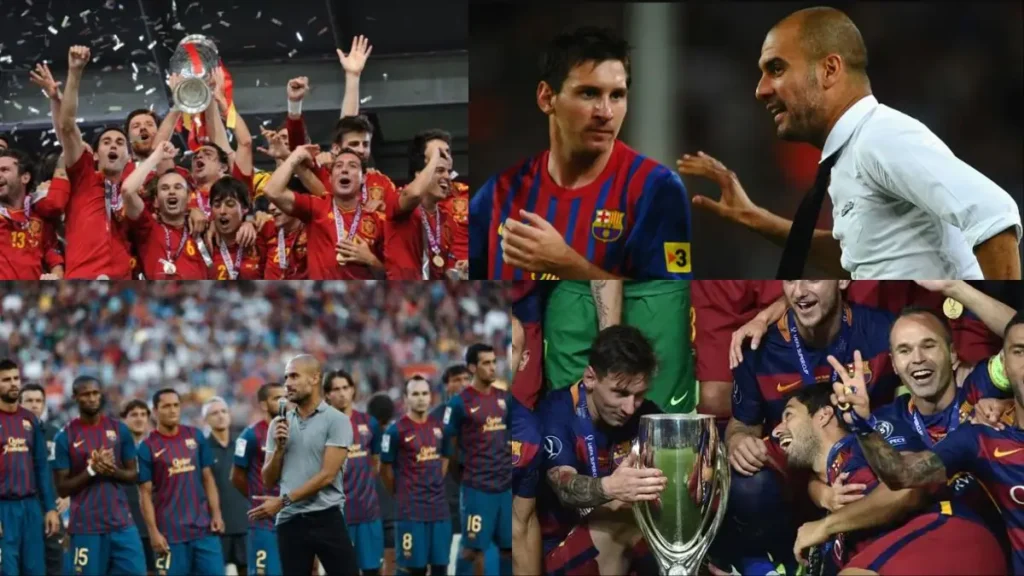
In April 2008, while celebrating the birth of his third child, Guardiola received an unexpected visit from president Laporta at the hospital. After congratulations, Laporta pulled him aside to discuss taking over the first team from Frank Rijkaard, who was struggling and planning to depart.
“You won’t have the courage,” Guardiola responded.
But Barcelona did have the courage. On May 8, 2008, following a 4-1 defeat to Real Madrid, the club announced that Rijkaard would leave and the 37-year-old Guardiola would become the youngest manager to lead Barcelona’s first team into a new era.
The Historic Treble Season (2008-09)
Guardiola’s debut season exceeded all expectations. He implemented his refined version of tiki-taka—a possession-based style emphasizing short, quick passes, relentless pressing, intelligent positioning, and constant movement. The system revolved around exceptional technicians like Xavi Hernández, Andrés Iniesta, and a young Lionel Messi, who formed the core with their technical brilliance and tactical understanding.
Barcelona’s start wasn’t smooth—they lost 1-0 to Numancia in their opening La Liga fixture and drew 1-1 with Racing Santander—but they quickly found their rhythm. By season’s end, they had accomplished something unprecedented in Spanish football: winning La Liga, the Copa del Rey, and the UEFA Champions League—the first Spanish club to achieve the continental treble.
In the Champions League final, Barcelona defeated Manchester United 2-0, making Guardiola, at 37, the youngest manager to win Europe’s premier club competition. But the success didn’t stop there. Guardiola’s Barcelona went on to win the Spanish Super Cup, UEFA Super Cup, and FIFA Club World Cup, becoming the first club in history to win six trophies in a single calendar year—the historic sextuple.
Continued Dominance (2009-2012)
The following seasons cemented Barcelona’s status as one of the greatest teams in football history. They won La Liga again in 2009-10 with a then-record 99 points, and captured another Champions League title in 2010-11, defeating Manchester United 3-1 at Wembley.
By January 2010, Guardiola had become Barcelona’s longest-serving Spanish manager, surpassing Josep Samitier’s record. In August 2011, after beating Porto 2-0 in the UEFA Super Cup, he became the record holder for most titles won as Barcelona manager with 12 trophies in just three years.
When Guardiola departed Barcelona in 2012, he left behind an extraordinary legacy: 14 major titles in 4 years, including 3 La Liga championships, 2 Champions League trophies, 2 Copa del Rey titles, 3 Supercopa de España titles, 2 UEFA Super Cups, and 2 FIFA Club World Cups. His record with the first team stood at 144 wins, 39 draws, and 17 losses in 200 matches.
Pep Guardiola German Challenge: Bayern Munich (2013-2016)
After taking a sabbatical year in 2012-13, during which he spent time in New York, Guardiola accepted the challenge of managing German powerhouse Bayern Munich for the 2013-14 season.
Tactical Evolution
At Bayern, Pep Guardiola evolved his tactical philosophy beyond pure tiki-taka. While maintaining core principles of possession and pressing, he integrated greater verticality, quicker transitions, and tactical flexibility. He worked with world-class talents including Robert Lewandowski, Arjen Robben, Franck Ribéry, and Philipp Lahm.
Domestic Dominance
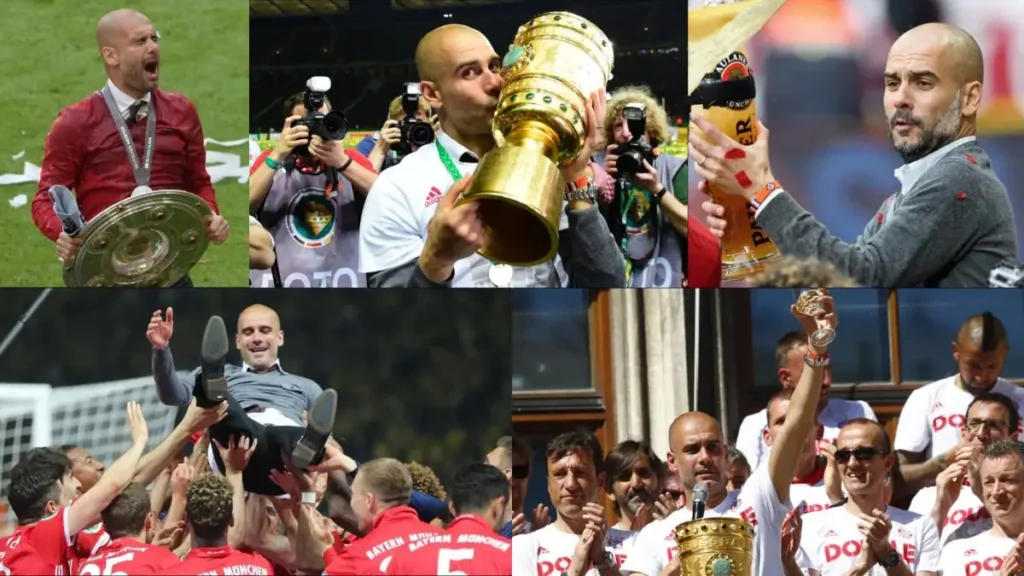
Guardiola’s Bayern Munich proved unstoppable domestically. They won the Bundesliga title in all three seasons (2013-14, 2014-15, 2015-16), claimed the DFB-Pokal twice (2013-14 and 2015-16), and secured both the UEFA Super Cup and FIFA Club World Cup in 2013.
His final Bundesliga record was remarkable: 82 wins, 11 draws, and just 9 losses—a testament to his tactical mastery and ability to adapt his philosophy to German football. In the DFB-Pokal, he recorded 14 wins, 3 draws, and no losses.
The Champions League Challenge
The one trophy that eluded Guardiola at Bayern was the Champions League. Despite reaching the semi-finals in each of his three seasons, Bayern couldn’t secure European glory. His final Champions League record with Bayern stood at 23 wins, 5 draws, and 8 losses.
His last match with Bayern came on May 21, 2016, when they defeated Borussia Dortmund in a penalty shootout to secure his seventh and final trophy with the German giants. In total, Guardiola added 7 major titles during his Bayern tenure.
Pep Guardiola Premier League Conquest: Manchester City (2016-Present)
In the summer of 2016, Guardiola accepted the challenge of managing Manchester City in the highly competitive Premier League. This would become his longest tenure at any club and produce some of his greatest achievements.
Building the Foundation (2016-2018)
Guardiola’s first season proved challenging as he adapted to English football’s intensity and overhauled the squad. However, the 2017-18 campaign was transformative. City won the Premier League with a record-breaking 100 points—the first team in English top-flight history to reach that milestone. They also claimed the League Cup, securing a domestic double.
This season established numerous records, including the most wins (32), most consecutive wins (18), most goals scored (106), and best goal difference (+79). Guardiola’s tactical influence was evident as his possession-based style, adapted for English football’s pace, overwhelmed opponents.
Historic Achievements (2018-2023)
The 2018-19 season saw City complete an unprecedented domestic treble—winning the Premier League, FA Cup, and League Cup—becoming the first men’s team in English football history to achieve this feat.
After winning the Premier League again in 2020-21, City made their first Champions League final appearance but lost 1-0 to Chelsea. However, Guardiola’s persistence paid off spectacularly in 2022-23 when City achieved their own continental treble—Premier League, FA Cup, and Champions League—defeating Inter Milan 1-0 in the final.
This made Guardiola only the second manager in history to win the Champions League with two different clubs, and he became the youngest to do so with Barcelona in 2009. City’s treble also included the UEFA Super Cup and FIFA Club World Cup, mirroring Barcelona’s historic achievement.
Unprecedented Dominance (2023-2024)
The 2023-24 season saw City make history by becoming the first team to win four consecutive English top-flight titles, a feat never before accomplished since the Football League began in 1888. This remarkable achievement cemented Guardiola’s status as English football’s most successful modern manager.
At Manchester City, Guardiola has now won 18 major trophies: 6 Premier League titles, 1 Champions League, 2 FA Cups, 4 League Cups, 3 Community Shields, 1 UEFA Super Cup, and 1 FIFA Club World Cup. His Premier League record alone is extraordinary: 184 wins in 250 matches, producing a win rate of 73.6%.
Pep Guardiola – All Records, Trophies, and Achievements
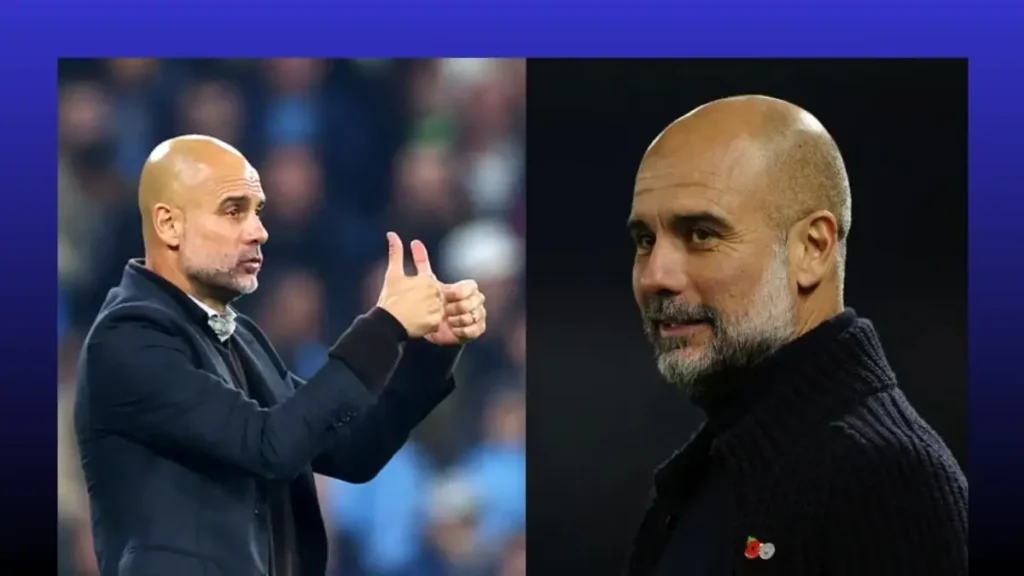
As Pep Guardiola reached his 1,000th game, the statistics paint a picture of unprecedented success:
Overall Record:
- 715 wins from 999 matches = 71.57% win rate
- 128 defeats and 156 draws
- 500+ goals scored during his Barcelona tenure alone
Trophy Cabinet:
- 40 major trophies in 1,000 games = one trophy every 25 matches
- 12 league titles across three countries
- 3 Champions League trophies (2009, 2011 with Barcelona; 2023 with Manchester City)
- 16 domestic cups across Spain, Germany, and England
- 4 FIFA Club World Cups and 4 UEFA Super Cups
Unique Achievements:
- First manager to win the sextuple (6 trophies in one calendar year)
- First to win two continental trebles with different clubs
- First to guide a team to 100 points in a Premier League season
- First to win four consecutive English top-flight titles
- Longest-serving manager in Manchester City history (10 seasons and counting)
Record-Breaking Milestones:
- Most consecutive wins in English top-flight history (15 straight victories)
- Most wins in a single month in English football’s top four tiers (9 wins in January 2021)
- Youngest manager to win the Champions League (at 37 years old)
Tactical Philosophy and Global Influence
Guardiola’s impact extends far beyond trophies. His tactical philosophy has fundamentally shaped modern football, inspiring managers worldwide.
Core Principles:
- Positional Play: The pitch divided into zones with structured player positioning to create numerical superiority
- High Pressing: Intense pressure to win the ball high up the pitch, a feature since his first Barcelona B match
- Possession Dominance: Controlling games through ball retention and tempo management
- Tactical Flexibility: Adapting tiki-taka principles to different leagues and opponents
Guardiola’s evolution from pure tiki-taka at Barcelona to more vertical, direct play at Manchester City demonstrates his ability to innovate while maintaining core values. His “new-age tiki-taka” embraces urgency and adaptability, making it effective against diverse tactical systems.
Recognition and Legacy
As Guardiola approached his 1,000th match, tributes poured in from football’s greatest figures. Sir Alex Ferguson, who managed over 2,000 games himself, welcomed Guardiola to the prestigious LMA Hall of Fame 1,000 Club:
“Your deep love and passion for the game has always been so evident, and you should be very proud of the indelible impact you continue to have across the global game.
Reaching 1,000 matches and achieving such longevity in Soccer is a landmark that can never be underestimated, and to continue to deliver league, Champions League, and domestic cup titles in three of Europe’s most competitive leagues is outstanding.”
Fellow managers including Jürgen Klopp, José Mourinho, Mikel Arteta, and Carlo Ancelotti, recorded video messages celebrating Guardiola’s milestone, acknowledging his revolutionary impact on the sport.
Reflections on an Extraordinary Journey
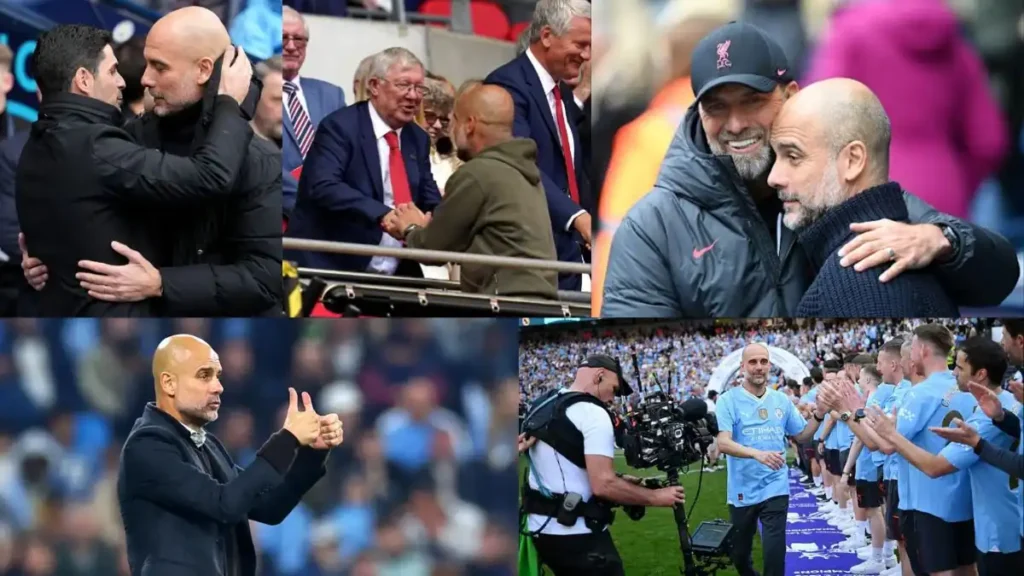
When asked about his remarkable statistics before the 1,000th game, Guardiola expressed disbelief at his own achievements:
“The numbers are insane. It’s difficult to reach it, and if I started again, I would not reach it. I never thought for one second about reaching 1,000 games. You just want to do a good job, play football the right way, and see what happens.”
He attributed his success to the exceptional players he’s coached and the dedication required to maintain such standards:
“Having a win rate over 70% means we win seven out of every ten games. This can happen because I’ve coached at Barcelona, Bayern Munich, and Manchester City with fantastic players. However, it also requires significant effort. Dedication, passion, and love—no one can outdo me in this regard.”
Guardiola acknowledged that his Liverpool match was the perfect occasion for his milestone: “Liverpool have been the biggest rival in this country, and it could not be better, to be honest. I think we pushed Liverpool to be better, and Liverpool pushed us to be better. That’s for sure.”
The Road Ahead
Despite reaching 1,000 games, Guardiola hinted that his career might not extend to another 1,000:
“If you ask me right now, it’s not going to happen 10,000 more. That is my feeling because life is so beautiful, but it’s not the one you have when you’re 20 years old. There are a lot of things I would like to do, not just being.”
However, his influence on football will endure regardless of when he decides to step away. From that humble 0-0 draw in Premia de Mar to standing as arguably the greatest manager of his generation, Pep Guardiola’s journey represents the pinnacle of what dedication, innovation, and football intelligence can achieve.
His story isn’t just about trophies—though 40 major titles speak volumes. It’s about revolutionizing how football is played, understood, and appreciated. From fourth-division pitches to Champions League finals, from demanding Pedro defend in the 89th minute to orchestrating historic trebles, Guardiola has remained true to his philosophy: play beautiful football, control the game, and never stop striving for perfection.
As he took his place on the touchline for that 1,000th match against Liverpool, Guardiola carried with him the weight of history and the admiration of the football world—a testament to an extraordinary journey that began with a dream and a simple belief in the beauty of the game.