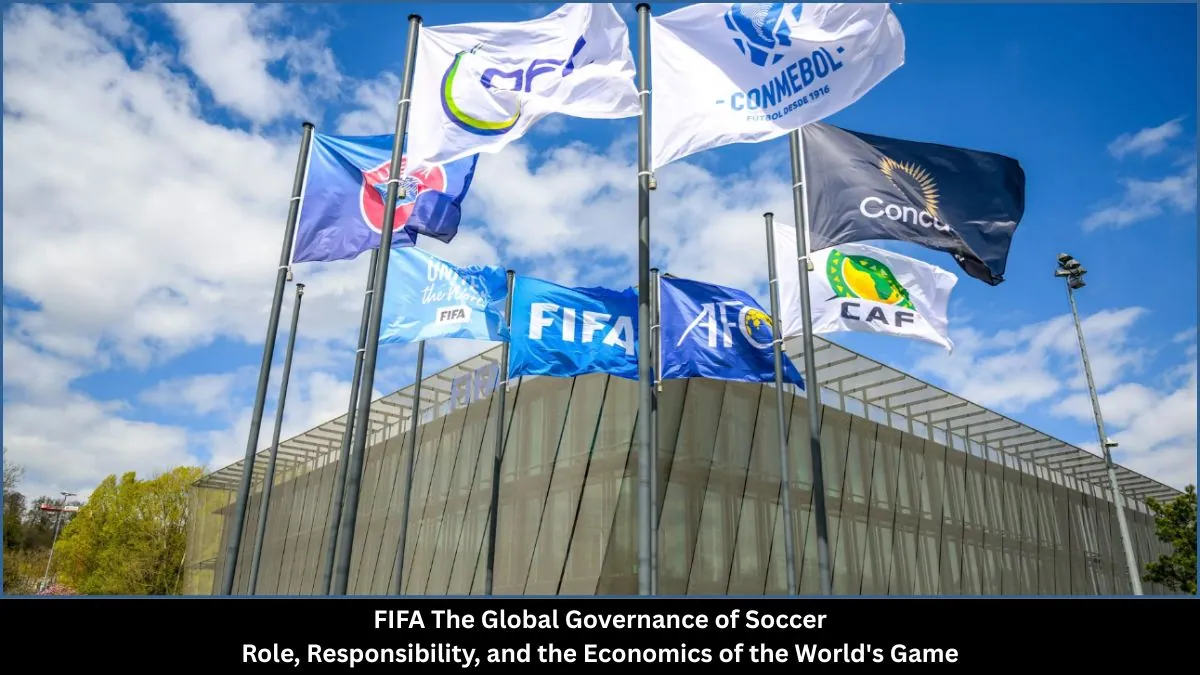
By the time the opening ceremony lights up the next FIFA World Cup stadium, over 5 billion people around the world will be watching. That’s not a typo. More than half the planet tunes in — from sports bars in Chicago to living rooms in Sydney, from Calgary’s hockey-crazed households making a rare soccer exception to first-generation immigrant families in Melbourne glued to the screen, cheering for their home countries.
Every breathtaking free kick, nail-biting penalty shootout, and heartbreaking group-stage exit is influenced by one of the most powerful — and controversial — governing bodies in organized sport: FIFA.
So what exactly is FIFA? How does it run the world’s most popular game? And why does it matter to fans in the United States, Canada, and Australia — three countries that are increasingly becoming major players in global soccer culture?
What Is FIFA, and Why Should You Care?
FIFA stands for Fédération Internationale de Football Association — the international governing body of soccer (or football, depending on where you’re from), futsal, and beach soccer.
This organization is responsible for organizing and promoting major international tournaments in the sport, most notably the FIFA World Cup.
Founded in Paris in 1904 with just seven member nations, FIFA today oversees 211 national member associations — more countries than are members of the United Nations.
If you’ve ever watched the World Cup, rooted for the USMNT or USWNT, followed the Canadian men’s team, Argentina, France, or Spain on their historic 2022 Qatar run, or watched the Socceroos battle in a knockout round, you’ve already experienced FIFA’s reach firsthand.
Every official international match, every World Cup qualifier, every FIFA ranking that determines seedings — it all flows through FIFA’s governance structure.
For American, Canadian, and Australian soccer fans, FIFA isn’t some distant bureaucratic organization. It’s the body that decides who hosts the World Cup (the 2026 edition lands in the USA, Canada, and Mexico — more on that later), who qualifies, and how the game is standardized across continents.
Key Information
- Founded — May 21, 1904
- Founder — Robert Guérin
- Founded — Rue Saint Honoré 229 in Paris, France
- Founding Members — Belgium, Denmark, France, Netherlands, Spain, Sweden, and Switzerland
- Head Office — Zurich, Switzerland
- Member Associations — 211 national
- First World Cup — 1930
- FIFA expanded beyond Europe — South Africa in 1909
- Revenues — US$5.8 billion (2019–2022 cycle)
- President — Gianni Infantino
- Senior VP — Salman bin Ibrahim Al Khalifa (AFC)
How FIFA Actually Governs Global Soccer
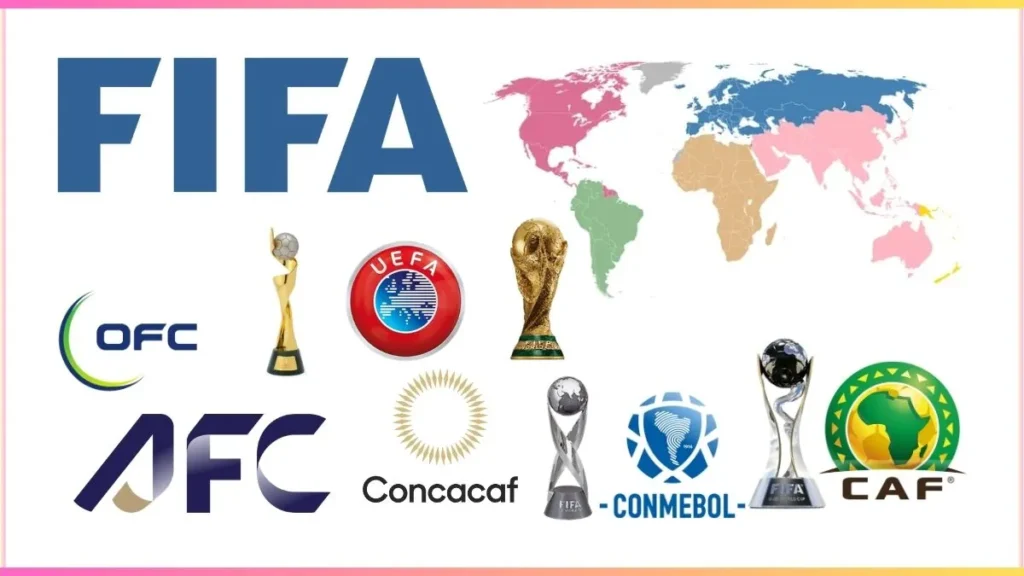
FIFA operates through a layered structure that connects the global to the local. At the top sits the FIFA Council, a governing executive body that includes representatives from FIFA’s six continental confederations:
- CONCACAF — North and Central America and the Caribbean (covers the USA and Canada) – 41 members
- AFC — Asia (covers Australia, which moved from OFC in 2006) – 47 members
- UEFA — Europe – 55 members
- CAF — Africa – 56 members
- CONMEBOL — South America – 10 members
- OFC — Oceania – 13 members
Each confederation manages regional competitions and qualifications, but FIFA sets the overarching rules, standards, and global tournaments. The FIFA Congress — essentially a general assembly of all 211 member associations — is the supreme decision-making body, meeting at least once a year.
At the operational level, FIFA employs over 1,000 people at its headquarters in Zürich, Switzerland, managing everything from anti-doping protocols and referee standards to financial distribution programs for developing nations.
The Economics of the World’s Game: Billion-Dollar Business
Here’s where things get really interesting — especially for fans who follow the business side of sports.
FIFA’s financial model is almost entirely built around one event: the World Cup. The 2022 Qatar World Cup generated a staggering $7.5 billion in revenue for FIFA. Compare that to the NFL’s Super Bowl, which generates roughly $700 million — and you start to understand the scale.
Where does that money come from?
Broadcasting Rights are the biggest driver. Networks in the US (Fox Sports, Telemundo), Canada (TSN, CTV), and Australia (SBS, Optus Sport) pay enormous licensing fees to air World Cup matches. Global broadcast deals alone accounted for over $3 billion in FIFA’s 2022 cycle.
Sponsorship and Commercial Rights from global brands — think Adidas, Coca-Cola, Visa, and Hyundai — make up another massive chunk. These brands don’t just pay for logo placement; they’re buying access to a global audience that no single sporting event on Earth can match.
Hospitality and Licensing — official merchandise, hospitality packages, and licensing fees from host nations — round out the revenue picture.
And what does FIFA do with all that money? According to their own financial reports, a significant portion — roughly $2.5 billion per World Cup cycle — is redistributed to member associations around the world. This is FIFA’s development mandate in action: using the revenue generated by soccer’s biggest stars to fund grassroots programs in nations that will never make a World Cup final.
FIFA and the 2026 World Cup: A North American Moment
For fans in the United States and Canada, the next few years represent a genuine watershed moment in their soccer history.
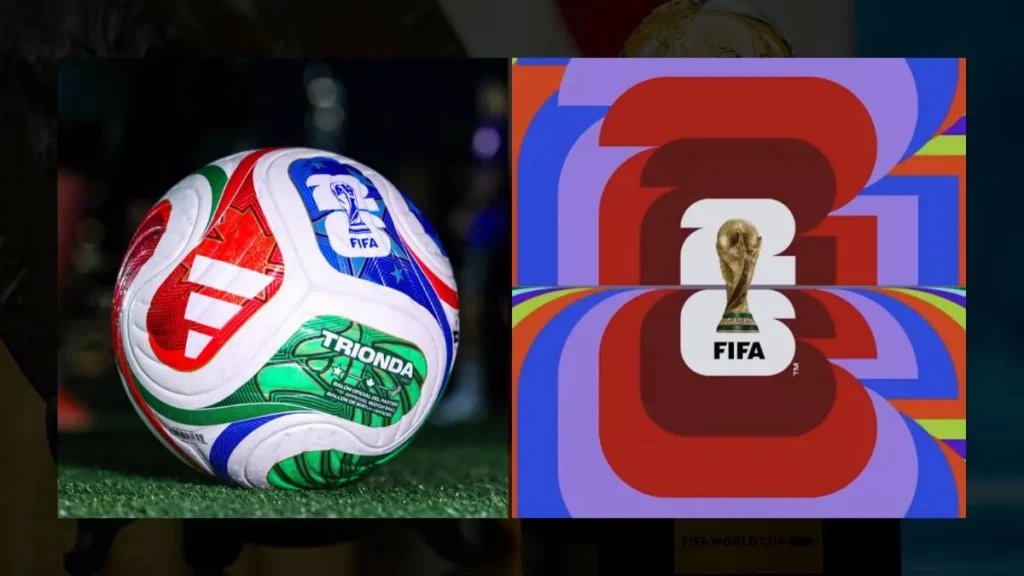
FIFA World Cup 2026 will be co-hosted by the USA, Canada, and Mexico — the first-ever three-nation World Cup and the first time the USA has hosted since 1994.
With 48 teams competing (expanded from 32) and 16 host cities, including iconic American venues like MetLife Stadium in New York/New Jersey, AT&T Stadium in Dallas, and SoFi Stadium in Los Angeles, this is North American soccer’s coming-out party on the grandest stage.
For Canadian fans still buzzing from Qatar 2022 — where the men’s national team qualified for the World Cup for the first time in 36 years — hosting matches in Toronto and Vancouver adds an extra layer of national pride.
The economic projections are staggering. FIFA and economic analysts estimate the 2026 World Cup could generate over $5 billion in economic activity for the United States alone, with millions of international visitors, global broadcast audiences, and tourism boosts in every host city.
The Controversy: Can FIFA Reform Itself?
No article about FIFA would be complete without acknowledging the elephant in the room: corruption and governance scandals.
The 2015 FIFA corruption scandal — where U.S. federal prosecutors indicted dozens of FIFA officials on charges of racketeering, wire fraud, and money laundering — sent shockwaves through global soccer.
Swiss authorities simultaneously opened their own criminal proceedings. Long-time FIFA President Sepp Blatter resigned. It was, by any measure, a catastrophic institutional failure.
The awarding of the 2022 World Cup to Qatar — with allegations of bribery and significant concerns about worker safety conditions during stadium construction — further damaged FIFA’s reputation.
Human rights organizations estimate that thousands of migrant workers died during the construction phase, a humanitarian crisis that sat uncomfortably alongside the world’s most celebrated sporting event.
In response, FIFA has implemented a series of governance reforms under current President Gianni Infantino, including stricter financial disclosure requirements, term limits for officials, and an independent audit committee. Critics argue these reforms don’t go far enough. Supporters say FIFA has made measurable progress.
For fans in the USA, Canada, and Australia — nations with relatively transparent sporting governance cultures — these issues resonate deeply. The conversation isn’t just about soccer; it’s about whether a $7.5 billion organization can hold itself to the same ethical standards it demands of players on the pitch.
FIFA’s Role in Growing Soccer in the USA, Canada, and Australia
One thing that often gets lost in the corruption headlines is FIFA’s genuine developmental role — and its impact on soccer growth in these three nations.
In the United States, FIFA’s investment and global visibility have directly fueled the rise of Major League Soccer (MLS), now one of the fastest-growing professional sports leagues in North America.
The league went from 10 teams in 1996 to 30 teams today, with franchises in cities like St. Louis, Nashville, and Charlotte that wouldn’t have been on anyone’s soccer radar a decade ago. The 2026 World Cup will accelerate this growth dramatically.
In Canada, the combination of FIFA’s expanded World Cup format (which gave Canada more qualifying opportunities), national federation investment, and homegrown talent like Alphonso Davies, Jonathan David, and Cyle Larin has created arguably the most exciting period in Canadian soccer history. The Canadian Premier League, launched in 2019, is building a domestic foundation that simply didn’t exist before.
In Australia, the Socceroos and the Matildas have cultivated passionate fanbases, and the 2023 FIFA Women’s World Cup, co-hosted with New Zealand, was a landmark cultural moment. The Matildas’ run to the semifinals electrified a nation, with match viewership breaking Australian TV records. FIFA’s decision to award Australia the co-hosting rights proved transformative.
The Future of FIFA: What Comes Next?
FIFA is navigating a rapidly changing landscape. The rise of club soccer — particularly the UEFA Champions League and the new FIFA Club World Cup (expanding to 32 clubs in 2025) — is challenging the primacy of international football. Players, clubs, and agents are pushing back on the increasingly crowded match calendar, raising legitimate concerns about athlete welfare.
There’s also the broadcast and streaming revolution to consider. As younger fans consume sports through platforms like DAZN, Apple TV+, and YouTube rather than traditional cable, FIFA is re-evaluating how it packages and sells its media rights. For fans in North America and Australia, this could mean more accessible, flexible viewing options in the coming years.
And looming over everything is the question of governance accountability — whether FIFA can build an institutional culture worthy of the game it oversees and the billions of fans who love it.
Final Thoughts: Why FIFA Matters Beyond the Scoreboard
Here’s the truth: you don’t have to love FIFA as an institution to love soccer. Plenty of fans — maybe most fans — separate the two quite comfortably.
But understanding FIFA matters because the decisions made in Zürich boardrooms shape the game you watch every weekend, from how your national team qualifies for the World Cup to whether your city gets to host a match, to how much investment flows into youth soccer programs in your community.
For the millions of soccer fans across the United States, Canada, and Australia who have watched this sport grow from a niche pastime into a mainstream obsession, FIFA is both the engine powering that growth and the institution most responsible for protecting the integrity of the world’s most beloved game.
The world is watching. FIFA, more than ever, needs to be worthy of that gaze.