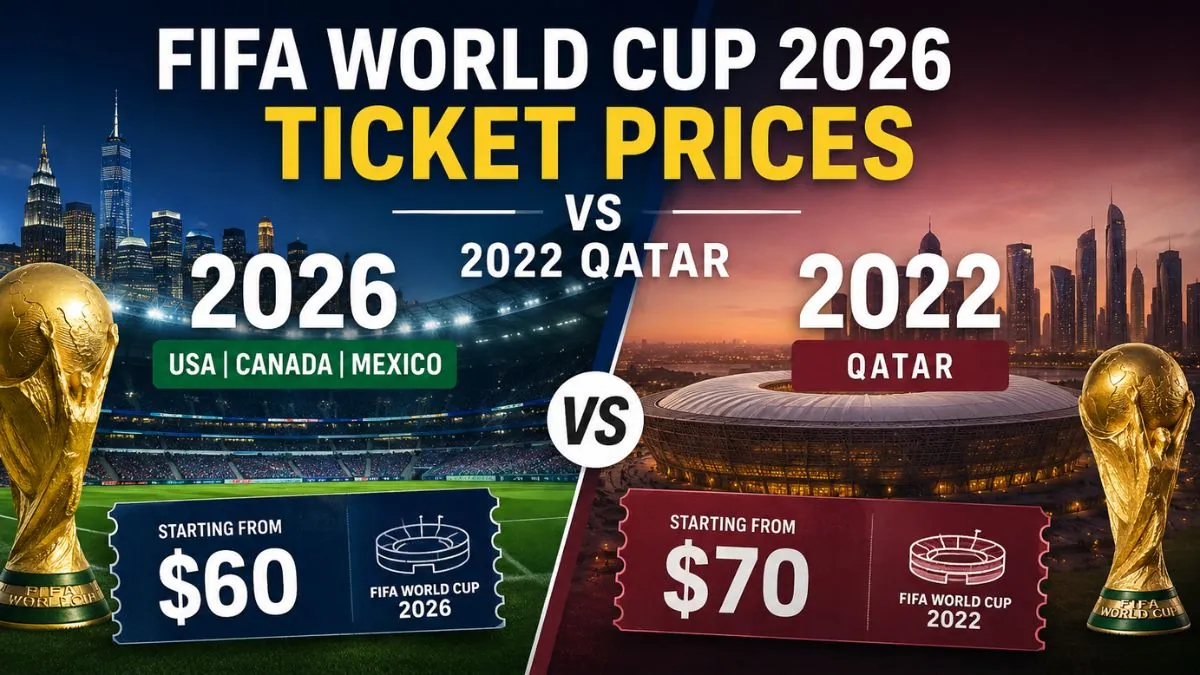
The initial ticket sale for the 2026 World Cup has revealed that FIFA is charging up to $10,990 (£8,333) for a seat at the final. These official ticket prices for the 2026 FIFA World Cup final are significantly higher than those for the 2022 Qatar final. Here’s what you need to know about the difference in FIFA World Cup 2026 Ticket Prices vs 2022 Qatar and how it will affect your wallet in just four years.
Let’s be honest — most of us have spent years dreaming about attending a FIFA World Cup in person. The noise, the color, the drama of 90 minutes that can break your heart or make your decade. For fans living in North America, the FIFA World Cup 2026 felt like a once-in-a-lifetime opportunity. Home soil. Dream matchups, finally.
Then the ticket prices dropped, and reality hit hard.
The 2026 World Cup, taking place in the USA, Canada, and Mexico, is expected to be significantly more expensive than the 2022 tournament in Qatar. Final tickets are reaching prices as high as $32,970, compared to approximately $1,600 in 2022.
In fact, general admission for the 2026 World Cup is being labeled the most expensive ever, often costing more than four times the price of similar seats from the previous tournament.
So what’s going on here? How do the ticket prices for the 2026 FIFA World Cup stack up against those from Qatar 2022, and why are fans calling it the most expensive World Cup ever? What’s fueling the outrage among fans, supporter groups, and even some governing bodies? Let’s break it all down.
The Numbers Don’t Lie: A Side-by-Side Comparison
To understand the anger, you first need to see the numbers in plain black and white. The Qatar 2022 World Cup used a fixed, four-category pricing structure. It wasn’t perfect, but it was predictable. Fans knew what they were paying before they even entered a queue.
For the 2026 edition, FIFA introduced dynamic pricing — a model borrowed from the airline and entertainment industries, where ticket costs fluctuate based on demand. The result? Prices that can change by the hour and hit levels that would make even the most dedicated supporter wince.
Here’s how the two tournaments compare across key match types:
| Ticket Category | Qatar 2022 Final Cost (Fixed) | 2026 Final Cost (April Open Sale) | 2026 Final Cost (May Peak “Front” Seats) |
|---|---|---|---|
| Category 1 (Top Tier) | $1,607 | $10,990 | $32,970 |
| Category 2 (Mid Tier) | $1,001 | $7,380 | Dynamic/Varies |
| Category 3 (Lower Tier) | $603 | $5,785 | Dynamic/Varies |
Group Stage Tickets
- Qatar 2022 (Category 4 cheapest): $11
- World Cup 2026 (cheapest general sale): $100
- Increase: Approximately 9x
Opening Match Tickets
- Qatar 2022 (Category 4): $55
- World Cup 2026 (Category 4 equivalent): $560
- Increase: Nearly 10x
Final Match Tickets
- Qatar 2022 (cheapest): $206
- World Cup 2026 (cheapest on general sale): $2,030
- Increase: Nearly 10x
Final Match Tickets (Top Category)
- Qatar 2022: $1,607
- World Cup 2026: $10,990 +
- Increase: Nearly 7x at face value — and far more on the resale market
That last point deserves extra attention. The cheapest seat available for the 2026 World Cup Final now costs more than the most expensive Category 1 Final ticket did in Qatar just four years ago. Let that sink in for a moment.
FIFA World Cup 2026 Ticket Prices vs 2022 Qatar – Why Are 2026 World Cup Tickets So Expensive?

Key Price Comparison (Qatar 2022 vs USA 2026)
- Final Ticket Prices: The top-tier 2026 final seat can exceed $32,970, with early sales starting at $8,970–$10,990. This is a massive jump from Qatar 2022’s top price of roughly $1,600.
- Opening Match Tickets: The 2026 opening game in Los Angeles saw the cheapest tickets starting around $1,200. In contrast, the 2022 opener saw general sales starting at $302.
- General Group Stage Tickets: While 2022 group stage tickets were relatively accessible (roughly $70), 2026 equivalent tickets have risen dramatically, with many priced around $300-$700.
- Supporter Tickets: Under pressure, FIFA has offered a limited subset of $60 tickets for 2026 to national federations.
The Dynamic Pricing Problem
The biggest structural change between 2022 and 2026 is FIFA’s shift to dynamic pricing. In Qatar, you could buy a Category 4 group stage ticket for $11 — yes, eleven dollars — at any point during the sales window. The price was locked. Predictable. Accessible.
In 2026, pricing changes based on demand, timing, and match popularity. A ticket that costs $500 today might cost $900 tomorrow if enough people try to buy it. FIFA tested this approach at the FIFA Club World Cup 2025 in the United States and carried the model into the full World Cup.
For regular fans — particularly those from outside North America used to European-style fixed pricing — this has been a culture shock.
The US Market Reality
FIFA President Gianni Infantino has been blunt about the reasoning. In a now widely-shared statement, he pointed to the US entertainment market as the benchmark: “We have to look at the market — we are in the market in which entertainment is the most developed in the world. So we have to apply market rates.”
He’s not entirely wrong, from a business perspective. Attending an NFL game, an NBA playoff, or a major concert in the United States routinely costs hundreds or even thousands of dollars. FIFA is essentially pricing the World Cup in line with America’s premium sports entertainment economy.
But here’s the problem: football — soccer, as they say stateside — has always prided itself on being the global sport. The people’s game. A tournament that belongs as much to a fan from Dakar or Jakarta or Bogotá as it does to a Silicon Valley tech worker with a $4,000 entertainment budget.
A 48-Team Tournament Means More Matches, But Not More Affordability
The 2026 World Cup is historic in another way — it’s the first edition with 48 teams, up from 32. There are 104 matches across the tournament, spread across 16 host cities in the United States, Canada, and Mexico. More matches should, in theory, mean more opportunities for fans to attend at a wider range of price points.
In practice, though, the expansion hasn’t driven prices down. If anything, the higher-profile matches — particularly USA games and marquee fixtures involving Brazil, Argentina, or France — are fetching prices that push ordinary fans completely out of the picture.
The Resale Market: Where Things Get Truly Wi
If the official prices feel steep, the secondary market is in an entirely different dimension.
FIFA’s own resale platform, FIFA Marketplace, was at one point listing four tickets to the July 19 Final in New York at over $2 million each. Yes, you read that correctly. Infantino himself addressed this, noting that the listing price doesn’t mean someone will pay it — but the fact that such listings existed at all tells you everything about the ecosystem FIFA’s pricing model has created.
Even at more grounded resale levels, tickets are routinely listed at double or more their original face value. The legal framework in the United States allows resale at any price, which FIFA used as part of its justification for higher face value prices in the first place — arguing that if they priced tickets too low, scalpers would simply absorb the margin.
It’s circular logic that leaves the average fan squeezed from both directions.
Fan Backlash and Legal Action
Football Supporters, Europe Goes to Court
The frustration hasn’t stayed on social media. Football Supporters Europe (FSE), one of the most prominent fan advocacy organizations in the world, branded FIFA’s pricing structure as “extortionate” and a “monumental betrayal” of supporters.
More significantly, FSE filed a lawsuit with the European Commission in March, targeting FIFA over what it called “excessive ticket prices” for the tournament. This is unprecedented territory — a major fan organization taking legal action against FIFA over pricing.
FSE also pointed out a broken promise: when the North American bid was submitted years ago, organizers had targeted ticket availability from as little as $21. The cheapest tickets that eventually went on general sale started at $60 — and even those were incredibly limited and largely unavailable to most fans.
The Technical Chaos That Made It Worse
Adding insult to injury, fans who actually managed to afford tickets faced a nightmare on FIFA’s ticketing website. Prospective buyers reported queuing for hours, only to receive error messages or be told tickets were sold out — despite seats remaining visible in the system.
For fans who had already been priced out emotionally, watching the process collapse technically was the final straw.
FIFA’s Response: A Limited Olive Branch
Under mounting pressure, FIFA did make one concession. A new “Supporter Entry Tier” was introduced, offering $60 tickets for every match in the tournament. On the surface, this sounds like good news.
In practice? The number of $60 tickets per game is estimated to be in the hundreds, not thousands. They’re allocated to national federations, which then distribute them to supporters who have attended multiple previous games for their national teams. If you’re a casual fan or someone attending your first international football event, you won’t be getting anywhere near these tickets.
FIFA’s own spokesperson described the move as supporting “travelling fans following their national teams across the tournament.” Critics, including FSE, called it an appeasement tactic that doesn’t address the fundamental pricing problem.
How Does This Compare to the Previous US World Cup
For some historical context, let’s go even further back. The United States last hosted the World Cup in 1994. At that time, ticket prices ranged from just $25 to $475. Accounting for inflation over three decades, that’s still a fraction of what fans are being asked to pay in 2026.
Even the 2018 World Cup in Russia sits as a distant memory of affordability by comparison. Category 1 Final tickets in Russia were $1,100. Qatar pushed that to $1,607. And now, in 2026, the same top category sits at roughly $11,000 — with resale prices pushing into the tens of thousands.
This isn’t just inflation. This is a fundamental reimagining of who the World Cup is for.
What Does It Actually Cost to Attend World Cup 2026?
If You’re Buying Tickets
For a group stage match, realistically budget $200–$600 per ticket on general sale, depending on the fixture and timing. For knockout stage matches, you’re looking at $500–$2,000+. The Final is a different world entirely.
Add in the Rest
Flights, hotels, and local transport in US cities during the tournament are not cheap. Accommodation in New York, Los Angeles, or Miami during World Cup weeks is already surging. A realistic budget to attend three to four group stage games, including flights and hotels, could easily reach $5,000–$10,000 for an international fan — before you’ve bought a single jersey or a stadium hot dog.
The $60 Ticket Lottery
If you’re a loyal supporter who has followed your national team extensively and you qualify through your federation, the $60 Supporter Tier ticket is technically available. But managing expectations here is important — the chances of an average fan securing one are slim.
FIFA’s Argument — and Why Many Fans Aren’t Buying It
Infantino has repeatedly defended the pricing by citing demand. He pointed out that FIFA received over 500 million ticket requests for 2026, compared to fewer than 50 million combined for the 2018 and 2022 World Cups. He also noted that 25% of group phase tickets were priced under $300.
But critics counter: if demand is that high and prices are still not selling out certain venues, something is broken. Miami’s Hard Rock Stadium, for instance, was reportedly struggling with thousands of unsold seats despite being a major football market. The USA vs Paraguay opener — one of the most anticipated group stage games — had tickets sitting unsold at prices ranging from $1,120 to over $4,100.
When even high-demand games can’t sell out at these prices, it suggests FIFA may have misjudged the elasticity of fan spending — or simply priced out too large a segment of its own audience.
The World Cup’s Identity Problem
There’s something worth grieving here beyond the price tags. The World Cup has always been a tournament where a fan from a small African nation could sit next to someone from Brazil or Germany and share ninety minutes of something larger than any of them. That vision — equal access, global belonging — is what made football “the beautiful game.”
The 2026 pricing model doesn’t just make the World Cup expensive. It makes it exclusive. And exclusivity, in football, has never been a feature. It’s always been the bug.
Whether FIFA adjusts its approach for future tournaments, faces regulatory consequences from the European Commission lawsuit, or simply concludes that the premium market will sustain its revenue targets, one thing is already written in the record books: