
FIFA President Gianni Infantino has unveiled a historic new international football tournament for Southeast Asia — the FIFA ASEAN Cup. Announced during the 47th ASEAN Summit in Kuala Lumpur, Malaysia, on October 26, 2025, the new competition aims to strengthen regional football ties and elevate the global profile of ASEAN nations.
This landmark event marks a major milestone for Southeast Asian football, coming as the region welcomes East Timor as ASEAN’s 11th member nation, its first expansion since the 1990s.
The creation of the FIFA ASEAN Cup underscores FIFA’s increasing emphasis on regional development and inclusivity in global football.
Designed to celebrate the passion, unity, and emerging talent across Southeast Asia, the tournament promises to deliver competitive football while fostering cooperation among member nations both on and off the pitch.
ASEAN Cup Tournament Overview and Format
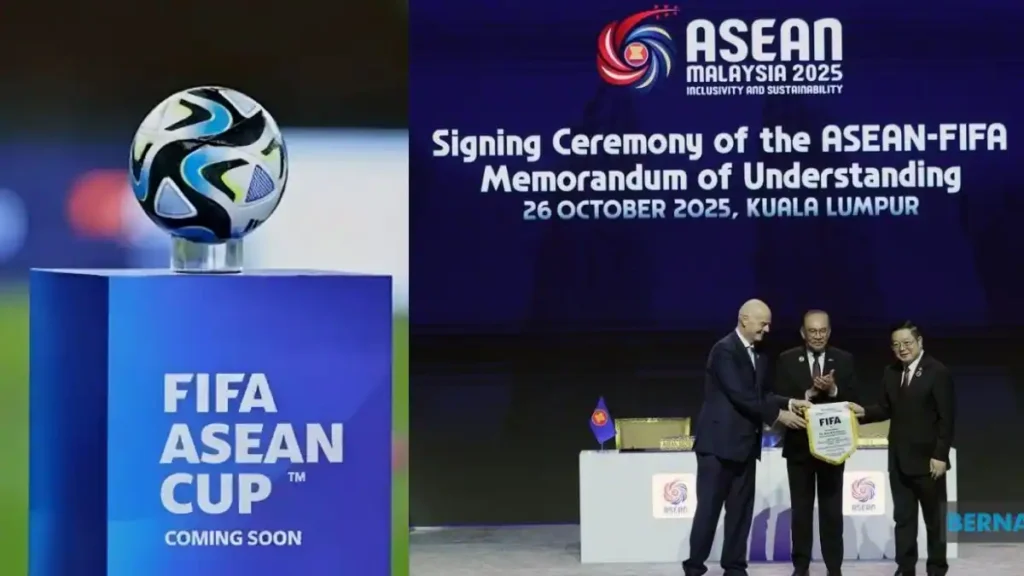
The FIFA ASEAN Cup will bring together all 11 ASEAN member nations in a format inspired by the successful FIFA Arab Cup, which FIFA first organized in 2021.
Unlike the current ASEAN Championship, this new tournament will take place during FIFA’s official international match windows, guaranteeing that clubs worldwide are required to release their players for national team duty.
Key Tournament Features
Official FIFA Recognition: The tournament will operate under FIFA’s direct oversight, providing enhanced prestige and global visibility for Southeast Asian football.
International Window Scheduling: Matches will take place during official FIFA dates, allowing ASEAN nations to call up their best players from leagues worldwide, significantly raising the competitive standard.
Arab Cup Model: The format follows the successful template of the FIFA Arab Cup, which features 16 teams in Qatar 2025 with qualifying rounds and a group stage leading to knockout phases.
Global Platform: FIFA President Infantino emphasized that the tournament will allow “the best players in the ASEAN region to shine on the global stage”.
Regional Impact and Significance
Timing with ASEAN Expansion
The tournament announcement coincided with East Timor’s historic admission as ASEAN’s 11th member after a 14-year campaign for membership. Infantino noted the symbolic significance, stating “The number 11 is a symbolic one in the footballing world as each team has 11 players”.
East Timor, officially known as Timor-Leste, brings the total ASEAN membership to 11 nations for the first time since the 1990s. The nation gained independence from Indonesia in 2002 and joined FIFA in 2005.
Complete ASEAN Member List
The FIFA ASEAN Cup will feature all 11 ASEAN member nations:
- Brunei
- Cambodia
- Indonesia
- Laos
- Malaysia
- Myanmar
- Philippines
- Singapore
- Thailand
- Vietnam
- East Timor (newest member)
Current Regional Football Landscape
Existing ASEAN Championship
Southeast Asia already hosts the ASEAN Championship (formerly AFF Cup), a biennial regional competition that has been running since 1996. Vietnam won the most recent edition in January 2025, defeating Thailand 5-3 on aggregate in the final.
Championship Records:
- Thailand: 7 titles (most successful)
- Singapore: 4 titles
- Vietnam: 3 titles
- Malaysia: 1 title
Regional World Cup Performance
Only Indonesia managed to advance beyond the third round of continental qualifying for the 2026 FIFA World Cup among ASEAN nations, underscoring the need for heightened competition to elevate regional football standards.
FIFA-ASEAN Partnership Renewal

Memorandum of Understanding
The tournament announcement was part of a renewed five-year Memorandum of Understanding between FIFA and ASEAN, signed by FIFA President Gianni Infantino and ASEAN Secretary-General Dr. Kao Kim Hourn. The agreement was witnessed by Malaysian Prime Minister Dato’ Seri Anwar Ibrahim, who currently chairs ASEAN.
Partnership Focus Areas
The renewed MOU targets five key development areas-
- Sports integrity promotion
- Social and economic development through sports
- On and off-pitch football development
- Inclusion promotion
- Climate change resilience support
Previous Collaboration Success
The initial 2019 agreement led to successful initiatives, including-
- FIFA Football for Schools programs
- Joint health campaign messaging
- Educational workshops across Southeast Asia
- Development projects targeting youth football
Development Goals and Vision
Boosting Regional Football
FIFA President Infantino outlined the tournament’s primary objectives during the announcement-
National Team Enhancement: “It will help boost national team football in the ASEAN region and will support the development of our sport across all of Southeast Asia”.
Global Recognition: The tournament aims to elevate ASEAN football internationally while providing a platform for regional talent to gain worldwide exposure.
Unity Through Football: Infantino emphasized that “through the FIFA ASEAN Cup, we are uniting countries together”.
Long-term Impact
The tournament is expected to:
- Accelerate football development across participating nations
- Increase international exposure for Southeast Asian players
- Attract greater investment in regional football infrastructure
- Enhance coaching and technical standards
- Boost youth development programs
Implementation Timeline
Stakeholder Engagement
FIFA will collaborate with key regional organizations to finalize tournament details.
- Asian Football Confederation (AFC)
- ASEAN Football Federation (AFF)
- FIFA Member Associations from all 11 ASEAN countries
Format Development
While specific details remain to be finalized, the tournament structure will follow the FIFA Arab Cup model-
- Qualifying rounds for lower-ranked teams
- Group stage with multiple groups
- Knockout phase featuring quarterfinals, semifinals, and final
- Professional organization matching FIFA standards
Regional Football Context
Current Competitive Levels
The 11 ASEAN nations show varying levels of football development-
Tier 1 (Regional Powers):
- Thailand: 7 ASEAN Championship titles, strongest regional record
- Vietnam: Recent ASEAN champions, rising football power
- Indonesia: Only ASEAN nation in the 2026 World Cup qualifying third round
Tier 2 (Competitive Nations):
- Singapore: 4 ASEAN titles, historically strong
- Malaysia: Former champions with solid infrastructure
- Philippines: Regular semifinalists, improving standards
Tier 3 (Developing Nations):
- Myanmar, Cambodia, Laos: Building football programs
- Brunei: Limited participation history
- East Timor: FIFA member since 2005, still developing
Global Football Integration
FIFA’s Regional Strategy
The FIFA ASEAN Cup is part of FIFA’s broader strategy to develop football in emerging regions through official tournaments. Similar initiatives include-
- FIFA Arab Cup (established 2021)
- Regional development programs across confederations
- Youth tournament expansion
- Women’s football initiatives
International Match Calendar Integration
By scheduling during official FIFA windows, the tournament ensures-
- Club cooperation in releasing players
- Higher competitive standards with full-strength national teams
- Global media coverage and recognition
- Professional organization meeting international standards
The FIFA ASEAN Cup is a major milestone for Southeast Asian football, aiming to raise the level of regional competition and give the region’s top talents a prestigious stage to shine on the global scene.
With FIFA’s active involvement and the symbolic timing of East Timor joining ASEAN, the tournament marks a fresh chapter in the growth of football across one of the world’s most vibrant regions.