


The countdown to the 2026 Soccer World Cup is on! Each day ahead of the tournament’s return to North America, so all You Need to Know About the 2026 FIFA World Cup Qualification Intercontinental Playoffs.
Six teams. Two spots. One shot at soccer immortality. The 2026 FIFA World Cup Intercontinental Play-offs are shaping up to be one of the most dramatic finales in World Cup qualification history — and for fans across the United States, Canada, and Australia, this is a story that’s impossible to ignore.
While the headline news is that 42 of 48 World Cup berths have already been locked in, the final chapter of qualification is still being written. And it’s going to be written in Mexico, during a March 2026 international window that will have billions of fans on the edge of their seats.
Here’s your complete breakdown of the 2026 FIFA World Cup Intercontinental Play-offs — the teams, the format, the fixtures, the stakes, and why these final two spots matter more than you might think.
What Are the 2026 FIFA World Cup Intercontinental Play-offs?

The intercontinental play-offs are FIFA’s mechanism for determining the very last two qualifying spots for the World Cup. Rather than leaving confederation runners-up without a path forward, FIFA creates a mini-tournament that pits the best remaining teams from different confederations against each other.
The play-off tournament — officially named the FIFA World Cup 2026 Play-Off Tournament — will determine two qualification spots for the 2026 FIFA World Cup, to be played in Canada, Mexico, and the United States.
The play-offs will feature six teams, split into two brackets of three teams, with both bracket winners qualifying for the World Cup.
Think of it as a mini-World Cup within the World Cup qualification process — high pressure, single-elimination, and absolutely unforgiving.
Why Are There Six Teams and Two CONCACAF Spots?

Here’s where the politics of FIFA governance get interesting — and it’s something fans in North America should understand clearly.
Each confederation received one play-off slot, except UEFA, with an additional play-off slot also given to the confederation of the host association(s). As Canada, Mexico, and the United States were subsequently appointed as hosts for the 2026 World Cup, CONCACAF received two spots in the play-off tournament, while the AFC, CAF, CONMEBOL, and OFC each received one.
That’s why you’ll see two CONCACAF nations competing rather than one. It’s a structural reward for hosting the tournament — and it creates a fascinating dynamic where two Caribbean nations could potentially end up facing each other in the semis before one goes on to claim a historic World Cup berth.
Already qualified teams for World Cup 2026
- Host nations: Canada, Mexico, United States
- Asia: Australia, Iran, Japan, Jordan, Qatar, Saudi Arabia, South Korea, Uzbekistan
- Africa: Algeria, Cape Verde, Egypt, Ghana, Ivory Coast, Morocco, Senegal, South Africa, Tunisia
- Concacaf: Curaçao, Haiti, Panama
- Europe: Austria, Belgium, Croatia, England, France, Germany, Netherlands, Norway, Portugal, Scotland, Spain, Switzerland
- Oceania: New Zealand
- South America: Argentina, Brazil, Colombia, Ecuador, Paraguay, Uruguay
Participating Teams by Confederation
| Confederation | Team | Qualification Method |
|---|---|---|
| AFC (Asia) | Iraq | Fifth round winners |
| CAF (Africa) | DR Congo | Play-off winners |
| CONCACAF | Jamaica | Best two third-round group runners-up |
| CONCACAF | Suriname | Best two third-round group runners-up |
| CONMEBOL | Bolivia | Seventh-place finishers |
| OFC (Oceania) | New Caledonia | Third round runners-up |
The Six Teams: Who’s Fighting for a Spot?
After months of grueling qualifying campaigns across five continents, here are the six nations who earned their place in the intercontinental play-offs:
DR Congo — Africa (CAF)
After one of the most dramatic qualification journeys on the African continent, the Democratic Republic of Congo emerged as CAF’s playoff representative. Africa sent DR Congo after they beat Cameroon in the playoff semifinal and then Nigeria in the final on penalty kicks. As the highest-ranked team among the six, DR Congo earned a seeded position — meaning they go directly to the final without playing a semifinal. This is a massive African footballing nation, and a World Cup berth would be a watershed moment for the country.
Iraq — Asia (AFC)
Asia’s playoff representative came down to a two-legged battle in Round 5. Iraq sealed the deal 3-2 over the two-legged series against the UAE to claim the AFC’s intercontinental playoff slot. Iraq is the second-highest-ranked team in the draw, earning them the other seeded position. It would be only Iraq’s second-ever World Cup appearance if they qualify — their first coming all the way back in 1986.
Jamaica — CONCACAF
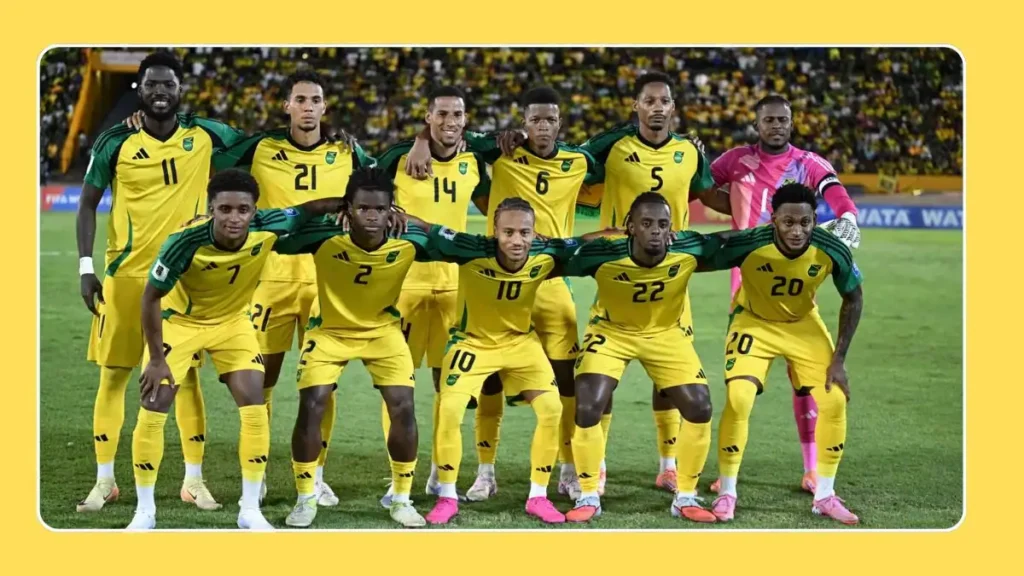
The Reggae Boyz are back on the big stage. Jamaica navigated CONCACAF’s expanded qualifying format to secure one of the confederation’s two playoff spots. With a passionate Caribbean fanbase and a diaspora community spread across the US, UK, and Canada, Jamaica vs. anyone is a compelling storyline. They last appeared at a World Cup in 1998 — a long-overdue return is on the line.
Suriname — CONCACAF
Perhaps the most surprising story of the entire CONCACAF qualification campaign. Suriname, a tiny South American nation that competes in the CONCACAF confederation due to historical and geographic ties, punched well above their weight to claim the second CONCACAF playoff berth. Curaçao became the smallest nation to ever qualify elsewhere in the process, but Suriname’s playoff spot represents an equally remarkable achievement for a nation with a population of under 700,000 people.
New Caledonia — Oceania (OFC)
The French Pacific territory had a remarkable OFC qualifying campaign. New Caledonia advanced to the OFC qualifying final only to lose to New Zealand — but that runner-up finish was enough to earn them the Oceania playoff berth. For context: New Zealand qualified directly, meaning New Caledonia goes to the playoffs as the OFC’s second-best team. Making the World Cup proper would be the greatest achievement in New Caledonian football history.
Bolivia — South America (CONMEBOL)
South America is arguably the toughest qualifying zone in world football — every match is a battle — and Bolivia came through as CONMEBOL’s sixth-place finisher to take the confederation’s playoff spot. Bolivia hasn’t appeared at a World Cup since 1994. At altitude in La Paz, they’re a handful for anyone; at sea level in Mexico in March 2026, it’ll be a very different test.
The Format: How It Works, Step by Step
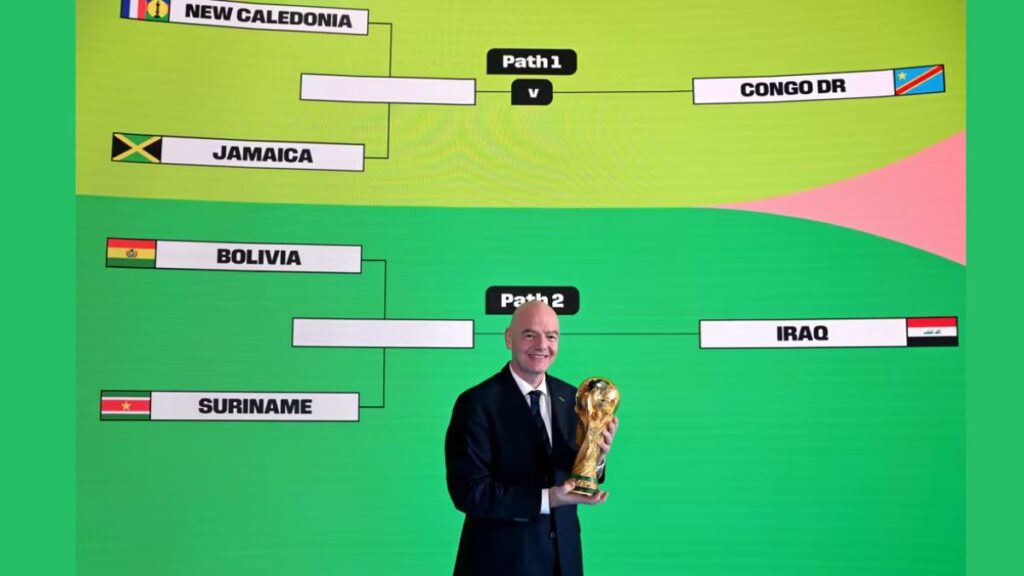
A play-off tournament involving six teams will be held to decide the last two FIFA World Cup berths. The bottom four teams in the November 2025 FIFA World Rankings were drawn into two single-elimination semifinal matches. The winners of those matches will advance to play the top two teams in a further round of single-elimination matches, and the winners will qualify for the World Cup.
Match Schedule & Path Brackets
Path 1 (Guadalajara Stadium)
- Semi-final: New Caledonia vs Jamaica
- Date: March 26 or 27, 2026
- Final: DR Congo vs Winner of New Caledonia/Jamaica (Pathway 1)
- Date: March 31, 2026
Path 2 (Monterrey Stadium)
- Semi-final: Bolivia vs Suriname
- Date: March 26 or 27, 2026
- Final: Iraq vs Winner of Bolivia/Suriname (Pathway 2)
- Date: March 31 or April 1, 2026
The winners of Pathway 1 and Pathway 2 will be awarded the final spots in Pot 4 of the 2026 World Cup draw.
Where Are the Games Being Played?
All games will be staged in Mexico, at Estadio Akron in Guadalajara, and Estadio BBVA in Monterrey.
Both are world-class venues — Estadio Akron is the iconic home of Club Deportivo Guadalajara (Chivas), while Estadio BBVA is the modern fortress of CF Monterrey. Hosting the play-offs in Mexico serves a dual purpose: it keeps the games in the host region and acts as a test run for the stadiums and logistics ahead of the 2026 World Cup.
The play-off tournament will be held in North America and will act as a preparatory event for the World Cup.
The Draw: How Teams Were Allocated
The draw took place on 20 November 2025 at the FIFA headquarters in Zurich, Switzerland. Teams were seeded based on the FIFA Men’s World Ranking of 19 November 2025. The teams ranked first and second were automatically allocated to play-off final 1 and 2, respectively. The remaining four teams were unseeded and placed into a single pot.
The two CONCACAF teams had to be placed into separate paths per FIFA’s general draw constraint — meaning Jamaica and Suriname cannot meet in the final; they must face each other only in a semifinal at the earliest. This prevents a scenario where both CONCACAF slots are taken by the same confederation.
Why These Play-offs Matter Beyond Just Two Spots
On the surface, this is a tournament to fill the 47th and 48th spots at the World Cup. But for the nations involved, the stakes are generational.
For Jamaica, qualifying would be a massive cultural moment — the Caribbean’s footballing credibility on the global stage, vindicated.
For DR Congo, it would represent one of the most populous African nations finally getting its moment at the world’s biggest sporting event.
For Iraq, it would end a 40-year World Cup drought in one of the sport’s most passionate football cultures in the Middle East.
For Bolivia, it’s about proving CONMEBOL’s sixth-best team can hold their own against the world — and ending a 32-year absence from the tournament.
For Suriname and New Caledonia, qualification would quite simply be the greatest sporting achievement in their nations’ histories, full stop.
What This Means for the 2026 World Cup Picture
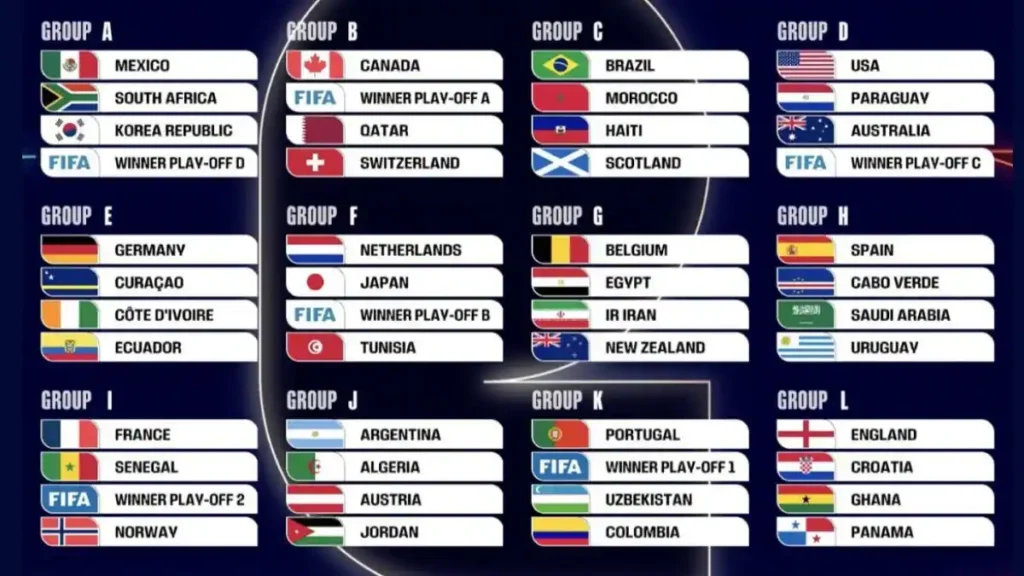
With 42 spots already confirmed and the UEFA play-offs set to finalize four more European berths on the same March 26 and 31 window, the entire qualification picture will be complete by March 31, 2026 — just weeks before the tournament kicks off on June 11, 2026.
The 2026 FIFA World Cup will be the first tournament in which all six confederations have at least one guaranteed berth — a historic milestone that underscores how far global football has come. By adding two more nations through the intercontinental play-offs, FIFA ensures that every corner of the world has a representative at the game’s greatest stage.
For fans in the United States watching from host cities, in Canada buzzing from their own Qatar 2022 debut, and in Australia still riding the high of the Matildas’ 2023 Women’s World Cup run — the intercontinental play-offs are the final act of a two-and-a-half-year global story that’s almost ready for its biggest chapter.
Key Dates of the 2026 FIFA World Cup Qualification Intercontinental Play-offs
| Event | Date | Venue |
|---|---|---|
| Semifinal 1: New Caledonia vs Jamaica | March 26, 2026 | Mexico |
| Semifinal 2: Bolivia vs Suriname | March 26, 2026 | Mexico |
| Final 1: DR Congo vs SF1 winner | March 31, 2026 | Mexico |
| Final 2: Iraq vs SF2 winner | March 31, 2026 | Mexico |
| 2026 FIFA World Cup Kickoff | June 11, 2026 | USA/Canada/Mexico |
The last two tickets are up for grabs. Six nations. Two dreams. And only one month to go.
Whether you’re rooting for a Cinderella story from New Caledonia, hoping to see Iraq end four decades of heartbreak, or just watching to see which teams fill out the World Cup bracket, the 2026 FIFA World Cup Intercontinental Play-offs deserve to be on your radar. Mark your calendars for March 26 and 31.